
information centre / Industry Information / Zirconia vs. Cemented Carbide: How to Choose Materials for Wear-Resistant Friction Pair Components?
Zirconia vs. Cemented Carbide: How to Choose Materials for Wear-Resistant Friction Pair Components?
Introduction
In mechanical equipment—such as pumps, valves, bushings, plungers, seal rings, and guides—friction pair components are subjected to prolonged sliding, compression, friction, and impact; consequently, material selection directly impacts both component service life and operational stability. Historically, cemented carbide was widely used for wear-resistant friction components due to its high hardness, high strength, and excellent wear resistance. However, with the advancement of sectors such as the chemical industry, precision machinery, semiconductors, new energy, and high-purity equipment, new operational demands have emerged. Requirements now extend beyond wear resistance to include corrosion resistance, low contamination levels, resistance to media erosion, and the ability to maintain stable performance over the long term. In this context, zirconia ceramics have increasingly become an alternative material for certain friction pair components. So, which is truly more wear-resistant: zirconia or cemented carbide? In reality, there is no absolute answer. The true comparison lies not in which material is harder, but in which is better suited to your specific operating conditions.
Quick Links
Contact Us
Live
E-mail:sales01@hkceramic.com
Zirconia and cemented carbide are, in essence, two different material systems.
Zirconia Ceramics
Zirconia (ZrO₂) is a type of high-performance structural ceramic.
Common types used in industrial applications include:
Y-TZP zirconia
Mg-PSZ zirconia
Partially stabilized zirconia
Among these, Y-TZP—characterized by high strength and fracture toughness—is a commonly used zirconia material for precision ceramic structural components.
Key characteristics of zirconia include:
High hardness + high strength + high fracture toughness + corrosion resistance + electrical insulation.
Cemented carbide
Cemented carbides typically consist of a hard phase—such as tungsten carbide (WC)—and a metallic binder phase; common binder phases include cobalt and nickel.
It features:
High hardness
High wear resistance
High compressive strength
Good machinability
Consequently, it is widely used in:
Molds
Cutting tools
Wear-resistant sleeves
Nozzles
Valve components
Sealing rings
High-load, wear-resistant parts
One of the major differences between the two is:
Zirconia belongs to the ceramic material system, whereas cemented carbide belongs to the metal-bonded composite material system.
Therefore, the two exhibit different characteristics regarding friction, corrosion, temperature, and electrical properties.
When comparing hardness alone, cemented carbide usually holds the advantage.
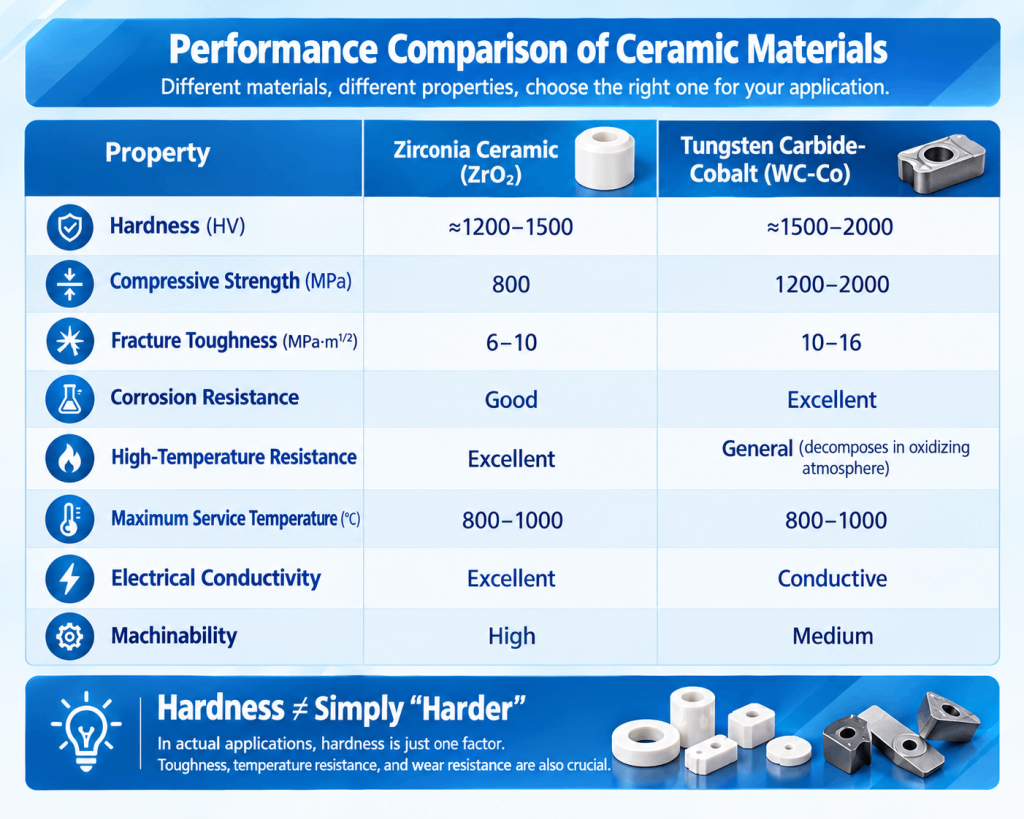
If comparing only hardness, cemented carbide usually has the advantage.
The WC hard phase in cemented carbide possesses extremely high hardness, making it particularly suitable for operating conditions involving:
Severe abrasive wear
High-load friction
Cutting wear
Severe particle erosion
The hardness of zirconia is generally lower than that of typical WC-Co cemented carbide.
Therefore, one cannot simply promote the idea that:
Zirconia is harder and more wear-resistant than cemented carbide.
This statement is not rigorous.
However, high hardness does not necessarily mean lower wear in all frictional environments.
Actual wear is also closely related to:
mating materials
load
speed
mode of friction
lubrication state
particle concentration
temperature
corrosive media.
therefore:
Cemented carbide typically offers significant advantages in environments characterized by high hardness and severe abrasive wear; however, this does not mean it outperforms zirconia in all media and frictional conditions.
The true advantage of zirconia lies not merely in its wear resistance, but in the balance between toughness and stability.
A significant advantage of zirconia in friction pair applications is its high fracture toughness.
In particular, stabilized or partially stabilized zirconia possesses a unique phase-transformation toughening mechanism that can impede crack propagation.
In simple terms:
When a crack begins to propagate in a localized area, zirconia crystals may undergo a phase transformation accompanied by a localized volume change, thereby hindering crack propagation.
This gives zirconia superior fracture resistance compared to many traditional ceramics.
Consequently, zirconia offers distinct advantages for precision friction pairs subjected to:
vibration
transient loads
micro-impacts
edge contact
complex stresses
The toughness advantage of zirconia is particularly noteworthy for ceramic components that are small in size, complex in structure, and require high reliability.
so:
The value of zirconia lies not merely in its superior wear resistance compared to cemented carbide, but in achieving an optimal balance of wear resistance, strength, toughness, corrosion resistance, and electrical insulation.
Why might zirconia offer advantages when exposed to corrosive media?
This may be a crucial reason for replacing cemented carbide with zirconia.
Cemented carbide is not, in the strict sense, a “pure tungsten carbide material.”
Taking the common WC-Co system as an example, a metallic binder phase is present.
In certain corrosive environments, the binder phase may be affected by chemical media, thereby altering the material’s surface condition and even impacting its long-term wear resistance.
Particular attention should be paid to the following:
Acidic media
Alkaline media
Salt solutions
Corrosive slurries
Chemical cleaning solutions
Wet processing environments
Zirconium oxide, being a non-metallic ceramic material, inherently possesses good chemical stability and corrosion resistance.
Therefore, in certain:
Simultaneous occurrence of wear and corrosion
…operating conditions, zirconia may offer advantages over traditional metal-based wear-resistant materials.
Of course, specific corrosion resistance still depends on:
Type of medium + concentration + temperature + contact time
Perform verification.
Zirconia vs. Cemented Carbide: Which Should You Choose?
When actually selecting materials, the choice can be determined based on the operating conditions.
① High load + severe abrasive wear
Examples:
Friction involving hard particles
Severe abrasive wear
High-load machining operations
Consider prioritizing:
Cemented carbide.
This is because its high hardness and high compressive strength offer significant advantages under such operating conditions.
② Simultaneous wear and corrosion
Examples:
Chemical slurries
Corrosive liquids
Acidic or alkaline media
Wet conveying equipment
Key material to consider:
Zirconia ceramics.
③ Presence of impact and vibration
If, in addition to friction, the component is subject to significant:
vibration
sudden impact
off-center loading
stress concentration
…then particular attention should be paid to the material’s:
fracture toughness and flexural strength.
In such cases, consider using:
zirconia or high-toughness cemented carbide.
④ Requirement for electrical insulation
If a friction pair requires both:
Wear resistance + Electrical insulation
Zirconia offers a distinct advantage.
This is because zirconia is an electrically insulating ceramic, whereas traditional cemented carbides are electrically conductive.
This is of practical value for applications in:
Semiconductor equipment
Precision electronic equipment
Electrical equipment
High-purity equipment
⑤ High-Temperature Conditions
Both materials can be used in certain high-temperature environments, but actual performance depends on the specific grade, temperature, atmosphere, and mechanical load.
Therefore, material selection should not be based solely on the “maximum temperature resistance.”
A comprehensive assessment is required, considering:
Operating temperature + thermal cycling + oxidizing environment + load + sliding speed.
Zirconia vs. Cemented Carbide: There Is No Absolute Winner in Wear Resistance
Both zirconia and cemented carbide are excellent wear-resistant materials, but their respective strengths differ.
It can be briefly summarized as follows:
Cemented Carbide
High Hardness + High Compressive Strength + Superior Wear Resistance
Better suited for:
Operating conditions involving high loads, severe abrasive wear, etc.
Zirconia Ceramics
High hardness + High toughness + Corrosion resistance + Electrical insulation
Better suited for:
Operating conditions involving wear, corrosion, and vibration, as well as requirements for insulation and cleanliness.
Therefore, when selecting materials for a friction pair, one should not simply ask:
“Which is more wear-resistant: zirconia or cemented carbide?”
The question we should be asking instead is:
“Under what conditions does the wear on my friction pair occur?”
Only by taking into account all factors—such as load, speed, temperature, medium, particles, lubrication conditions, mating materials, and service life requirements—can a truly suitable material be selected.
It is not a case of “the harder, the better” or “the more expensive, the better”; rather, the goal is to precisely match material properties to actual operating conditions.
If you are considering replacing cemented carbide with zirconia for your equipment, please provide the specific part drawings and operating parameters. Haide Precision Ceramics can conduct a comprehensive assessment—covering everything from material selection and structural design recommendations to precision machining—to deliver customized ceramic solutions for wear-resistant friction pairs.
Dongguan Haikun New Materials Co., Ltd. specializes in industrial ceramic materials—such as zirconia, alumina, and silicon nitride—and the processing of precision ceramic components.
For wear-resistant friction pair components, we offer material matching and precision machining tailored to the customer’s specific operating conditions.
Zirconia Ceramics
Suitable for applications requiring:
Wear resistance + High toughness + Corrosion resistance + Electrical insulation
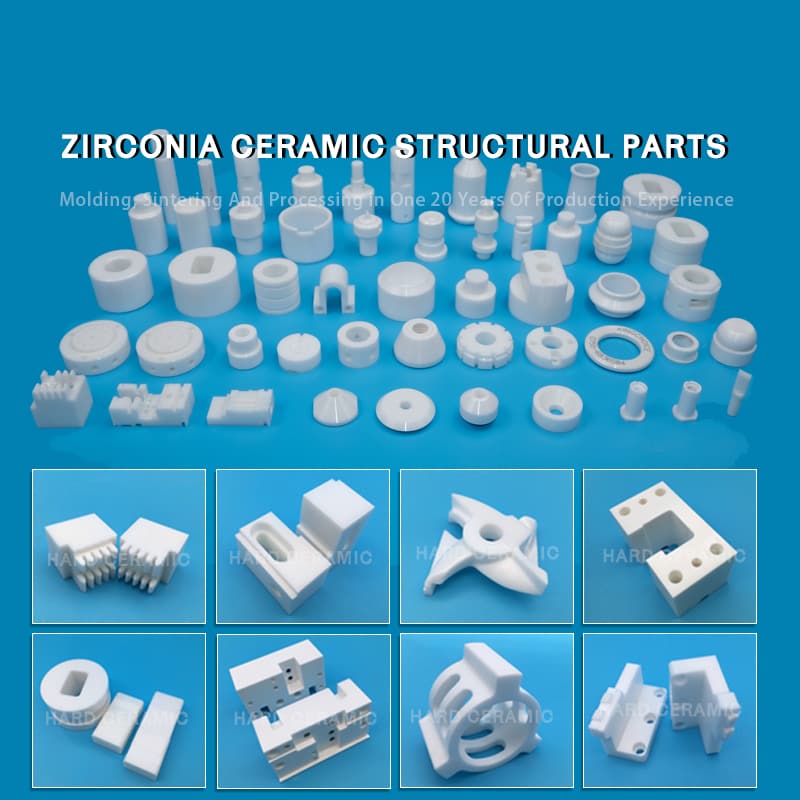
Machinable components:
Ceramic plungers
Ceramic valve cores
Ceramic sealing rings
Ceramic bushings
Ceramic guides
Precision structural components
Alumina Ceramics
Suitable for:
Wear resistance + Insulation + High-temperature resistance + Cost-effectiveness
Applications.
Silicon Nitride Ceramics
Suitable for:
High speed + High strength + High toughness + Thermal shock resistance
Applications.
Haikun Precision Ceramics offers the following processes:
Forming → Sintering → CNC Precision Machining → Precision Grinding → Lapping → Polishing → Inspection
We support:
Customization based on drawings or samples, small-batch prototyping, and mass production.
For friction pair components, we conduct comprehensive analyses based on customer-provided data—such as:
Operating load
Rotational speed
Friction mode
Counter-material
Operating temperature
Lubrication conditions
Corrosive media
Service life requirements
—to select the most suitable materials and processing solutions.
Relevant information