
information centre / Industry Information / How to choose between 95% and 99% alumina ceramics? The impact of alumina ceramic purity on operating conditions.
How to choose between 95% and 99% alumina ceramics? The impact of alumina ceramic purity on operating conditions.
Introduction
In the selection of industrial ceramics, 95% alumina ceramics and 99% alumina ceramics are two very common materials. Many customers directly ask, “Is 99% alumina ceramics, with its higher purity, necessarily better than 95% alumina ceramics?” The answer isn’t so simple. Both 95% and 99% alumina ceramics belong to the alumina ceramic family, but they differ in alumina content, formulation, and sintering process. Therefore, they differ in mechanical properties, insulation properties, thermal properties, corrosion resistance, dimensional stability, and cost. Truly professional selection doesn’t simply pursue higher purity, but rather matches the product’s operating temperature, mechanical load, electrical properties, corrosive environment, wear resistance requirements, and cost budget. So, what are the differences between 95% and 99% alumina ceramics? In what situations should 95% alumina ceramics be chosen? In what situations is 99% alumina ceramics more suitable?
Quick Links
Contact Us
Live
E-mail:sales01@hkceramic.com
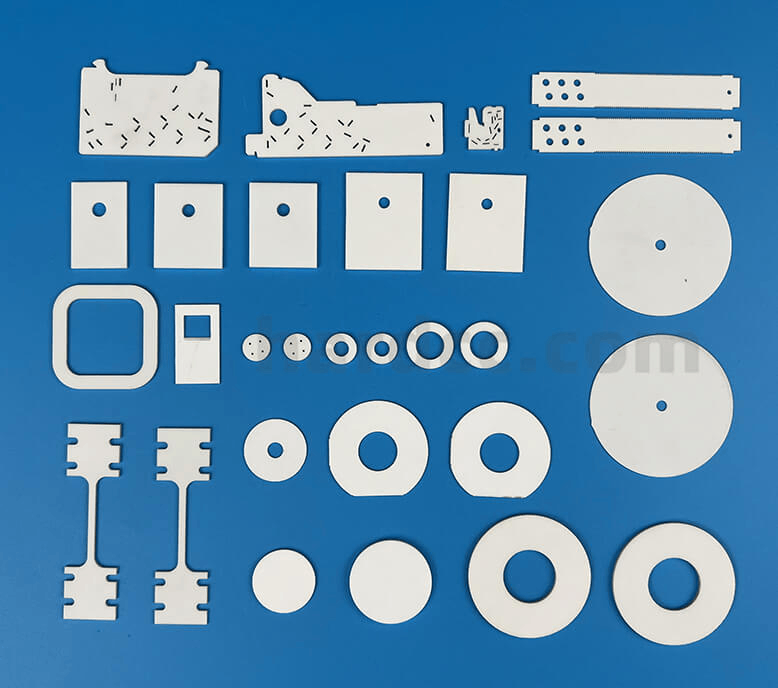
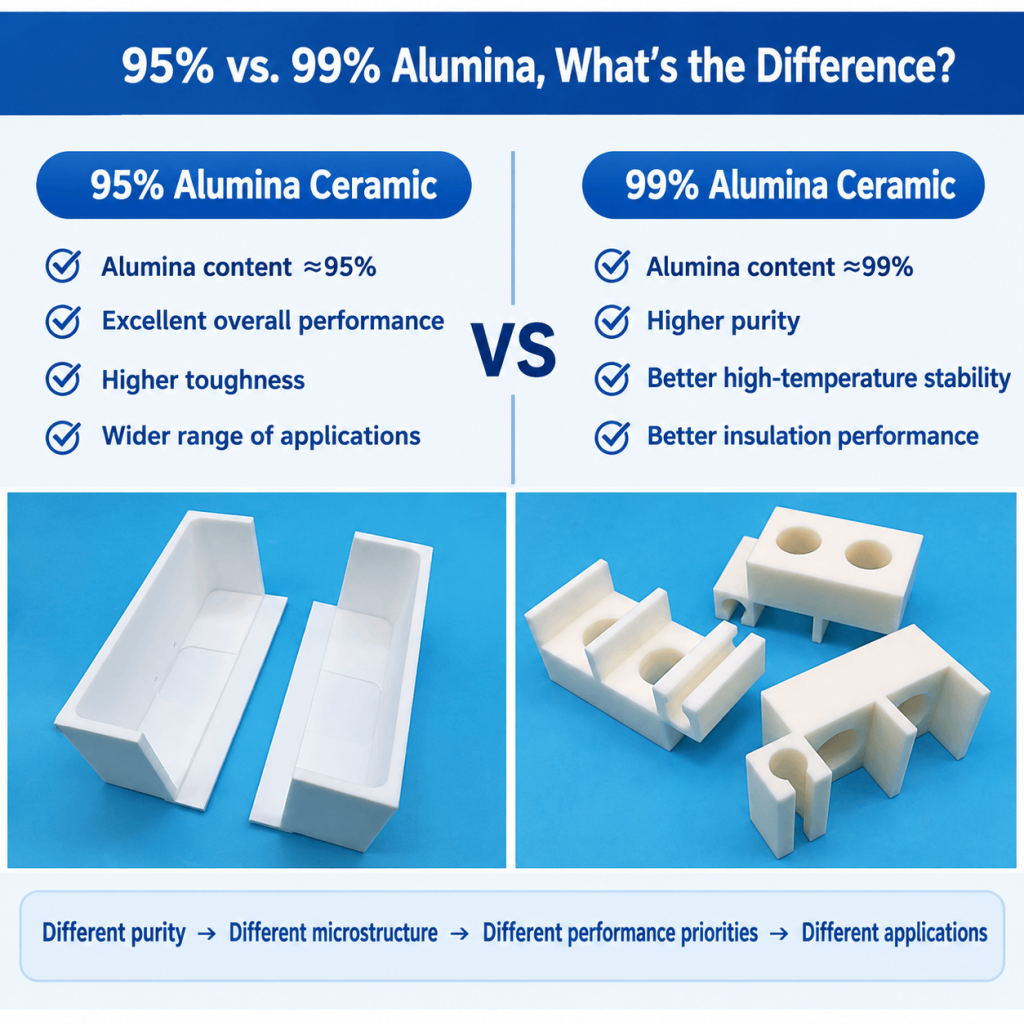
What are the differences between 95 ceramic and 99 ceramic?
The terms “95 porcelain” and “99 porcelain” are usually distinguished based on the alumina (Al₂O₃) content in the ceramic material.
95% Ceramics
The alumina content is typically around :95%.
Due to the presence of other components in certain proportions, it possesses good overall performance and processing economy, making it a widely used alumina ceramic in industrial applications.
99% ceramic
The alumina content is typically:around 99%.
The material has higher purity and generally exhibits better high-temperature stability, insulation properties, chemical stability, and dimensional stability.
In simple terms:
95% purity ceramics emphasize overall performance and cost-effectiveness; 99% purity ceramics emphasize performance stability under high-purity conditions.
It’s important to note that different manufacturers use different formulas, molding methods, and sintering processes. Even with the same label of 95% or 99%, actual performance may vary.
Therefore, one cannot rely solely on the number “95” or “99”.
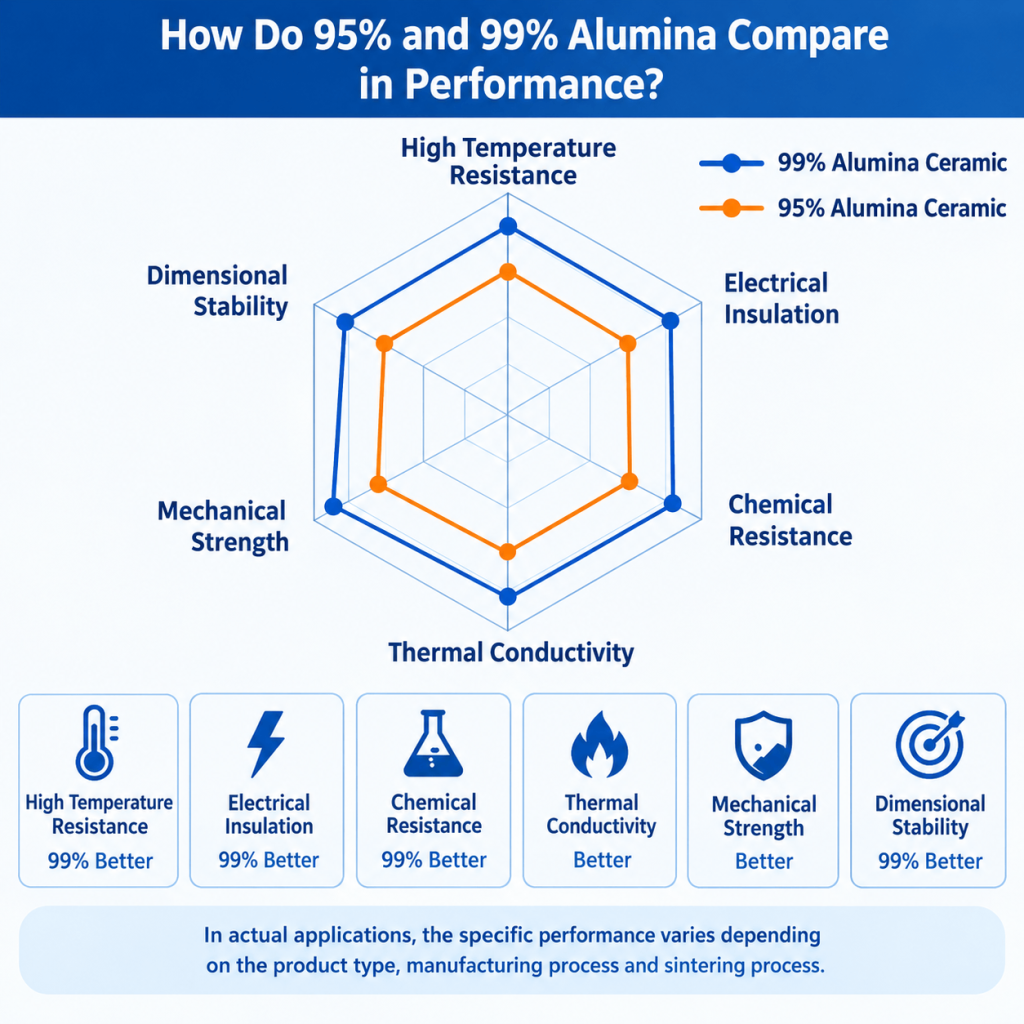
How much difference is there in performance between 95% ceramic and 99% ceramic?
Increasing the purity of alumina alters the microstructure of the ceramic, including the glassy phase and impurity phases, thus affecting the overall performance of the material.
This can generally be understood from the following aspects.
① High Temperature Resistance
99% ceramic materials, due to their higher alumina content, generally exhibit better stability at high temperatures.
If a product needs to operate in a high-temperature environment for extended periods, or if high dimensional stability at high temperatures is required, 99% ceramic materials are often more advantageous.
②Electrical Insulation Properties
Alumina itself possesses excellent electrical insulation properties.
High-purity alumina generally provides more stable insulation performance; therefore, 99% alumina is often used in applications requiring high insulation reliability.
Examples:
High-voltage insulation components
Vacuum equipment insulation components
③ Corrosion Resistance
Alumina ceramics generally possess good chemical stability.
In certain high-temperature, corrosive, or high-purity environments, 99% alumina ceramics, due to their lower impurity content, typically offer better material stability.
However, specific corrosion resistance still depends on:
acid/alkali type + concentration + temperature + contact time
Semiconductor equipment parts
Electronic ceramics
Precision electrical structural components
Make a judgment.
④ Thermal Properties
Alumina ceramics possess a certain degree of thermal conductivity.
Generally, as the purity of alumina increases, the material’s thermal properties also change. However, the actual thermal conductivity is not solely determined by purity; it is also influenced by factors such as:
Porosity
Grain structure
Sintering aids
Material formulation
Sintering process
Therefore, it is best to directly confirm the actual material parameters provided by the supplier during procurement.
Is 95 ceramic a low-performance ceramic? Why is it so widely used?
Many people have a misunderstanding when they see “95” and “99”:
95 ceramics have low purity, so their performance is definitely poor.
Actually, that’s not the case.
While 95% pure ceramic has a lower purity than 99% pure ceramic, it is still a high-performance engineering ceramic material.
For many conventional industrial applications, 95% pure ceramic is sufficient to meet the requirements.
For example:
General insulation applications
Including:
Insulating sleeves
Insulating gaskets
Ceramic supports
Electrical insulation parts
95% ceramic is usually sufficient.
Common wear-resistant applications include:
Ceramic bushings
Guide rings
Wear-resistant rings
Wear-resistant bushings
If the temperature and medium environment are not particularly harsh, 95% ceramic often has a better cost advantage.
General-purpose high-temperature structural components
In environments without extreme high temperatures and high purity requirements, 95% ceramic can still be an economical and practical material choice.
Therefore:
Not all products require 99% ceramic.
If 95% ceramic is sufficient for the actual operating conditions, blindly upgrading to 99% ceramic may only increase procurement costs without bringing commensurate benefits.
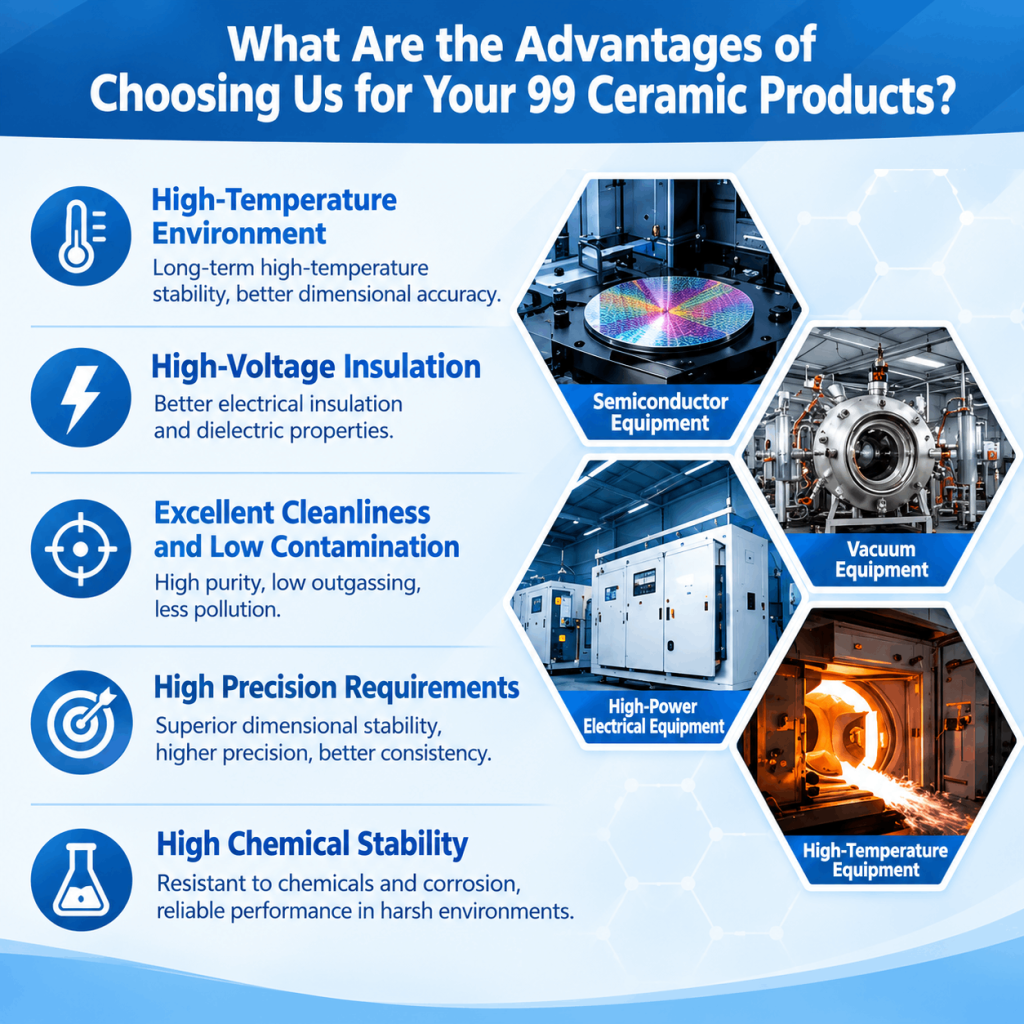
In what situations is 99 ceramics a better choice?
The advantages of 99% ceramic become more apparent when the product operates in a more demanding environment.
① High-Temperature Environment
If the parts are exposed to high temperatures for extended periods and have high requirements for:
Dimensional stability
Material stability
Long service life
99% ceramic can be given priority consideration.
② High-voltage insulation
For high-voltage, high-frequency electrical applications, greater attention needs to be paid to the insulation reliability of ceramics.
99% ceramic is generally suitable for precision applications with high requirements for electrical insulation performance.
③ Vacuum and Clean Environments
Industries such as semiconductors and vacuum equipment have higher requirements for materials in terms of:
purity,
outgassing,
contamination control,
surface quality, and
chemical stability.
In these situations, high-purity alumina ceramics often have a greater advantage.
④ High Requirements for Dimensional Stability
For positioning components, support components, and insulating structural components in precision equipment, if the product needs to maintain stable dimensions over a long period, then the purity of the material, the sintering quality, and the processing technology are all crucial.
In these applications, 99% pure ceramic is often a more worthwhile consideration.
Therefore:
The more severe the operating conditions and the higher the requirements for material stability, the more significant the application value of 99% pure ceramic becomes.
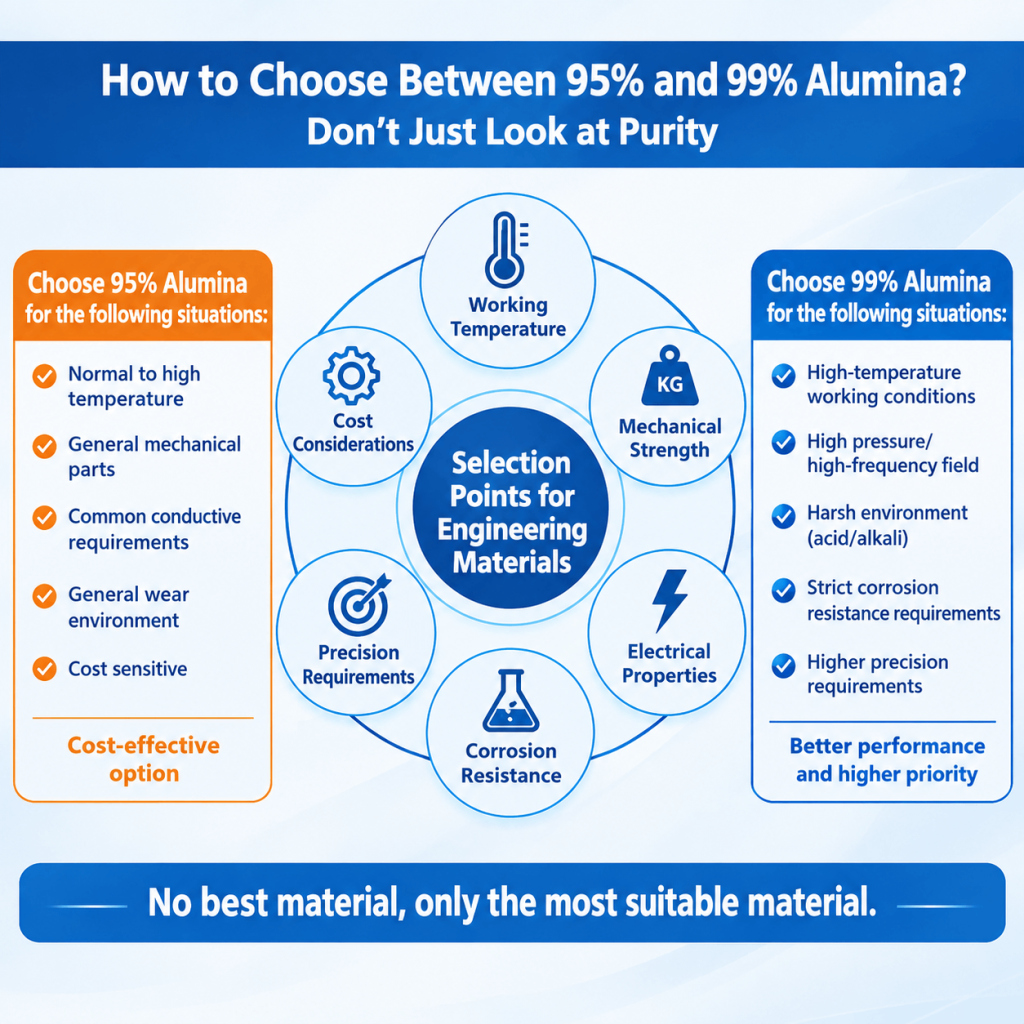
How to choose between 95% and 99% ceramic? Don't just look at the purity.
To determine whether to choose 95% or 99% porcelain porcelain, you can consider the following questions.
If cost-effectiveness is the primary consideration
The product only requires:
Standard insulation
General wear resistance
Ordinary high temperature resistance
A certain mechanical strength
Therefore:
95 porcelain is usually a more economical choice.
For long-term high-temperature operation,
key considerations:
Temperature + Thermal stability + Dimensional stability
Priority should be given to:
99% ceramic.
For high-voltage insulation:
Key considerations:
Insulation performance + Breakdown performance + Material density + Processing quality
For applications with high requirements, consider:
99% ceramic.
For use in semiconductor or vacuum equipment:
Key considerations:
Purity + Cleanliness + Outgassing characteristics + Dimensional stability + Surface quality
Generally more suitable for:
High-purity alumina ceramics.
If the product structure is complex, the quantity is large, and the cost is sensitive,
while meeting performance requirements:
95% ceramic often offers a higher overall cost-performance ratio.
Therefore, the truly reasonable selection logic should be:
First determine the operating conditions → then determine the performance requirements → finally determine the material purity.
Instead of:
First choose 99% ceramic → then try to adapt the product to 99% ceramic.
95 ceramic or 99 ceramic? There's no absolute answer, only the more suitable material.
The biggest difference between 95% and 99% ceramics isn’t just the difference in the “95” and “99” designations, but rather the differences in microstructure, performance, and application range resulting from the change in material purity.
In short:
95% ceramics: Focus more on overall performance and cost-effectiveness.
99% ceramics: Focus more on high purity, high-temperature stability, insulation reliability, and long-term stability under harsh environments.
For general industrial insulation, wear resistance, or general high-temperature applications, 95% ceramic is often sufficient.
If the application is in semiconductor, vacuum, high temperature, high pressure or high cleanliness environments, where the stability of the material is required to be higher, 99 ceramics are usually more worth considering.
However, it should be noted that:
Higher alumina purity does not necessarily mean a simple “comprehensive improvement” in all properties.
The final performance is also closely related to the material formulation, molding method, sintering process, density, grain structure and post-processing quality.
Therefore, the most important principle in selecting industrial ceramics is not:
“The higher the purity, the better.”
Instead:
“Choose the most suitable and economical material while meeting the operating requirements.”
If you are selecting 95% or 99% ceramic, you can provide product drawings, operating temperature, load, insulation requirements, operating medium, and precision requirements. Haikun Precision Ceramics can assist in material selection and precision machining based on the actual operating conditions.
Haikun Precision Ceramics can provide customized solutions based on working conditions, including both 95 and 99 grade ceramics.
Dongguan Haikun New Materials Co., Ltd. focuses on the research, development, production and precision processing of alumina ceramics and high-performance industrial ceramic materials. We can assist customers in selecting more suitable alumina ceramic materials based on their product drawings and actual operating conditions.
95% Alumina Ceramic
Key Advantages:
Excellent overall performance + Controllable cost + Wide range of applications
Suitable for:
Insulating components
Wear-resistant components
Ceramic tubes
Ceramic rings
Ceramic sleeves
Ceramic structural components
General high-temperature parts
99% Alumina Ceramic
Key Advantages:
High purity + High temperature stability + Good insulation + Chemical stability
Suitable for:
Semiconductor equipment
Vacuum equipment
High-temperature equipment
High-voltage insulation
Precision electronic equipment
High-cleanliness environments
High-precision structural components
Haikun Precision Ceramics offers:
Dry pressing | Isostatic pressing | Injection molding | High-temperature sintering | CNC precision machining | Precision grinding | Grinding and polishing | Laser processing
And supports:
Customization based on provided drawings, processing based on provided samples, small-batch prototyping, and mass production.
For customers requiring high-precision alumina ceramic parts, we can develop corresponding material and processing solutions based on the product’s dimensions, thickness, precision, surface roughness, operating temperature, mechanical load, and operating medium.
Relevant information