
information centre / Industry Information / What is the difference between compressive strength and impact resistance in industrial ceramic materials?
What is the difference between compressive strength and impact resistance in industrial ceramic materials?
Introduction
Industrial ceramics, characterized by high hardness, high strength, wear resistance, and high temperature resistance, are widely used in semiconductors, machinery manufacturing, new energy, and medical devices. However, during the selection of ceramic materials, a question is often raised: “Since ceramics have such high compressive strength, does that mean they are necessarily impact resistant?” Actually, no. Compressive strength and impact resistance are two different performance concepts. High compressive strength does not mean the material is not prone to fracture under sudden impact. Understanding the difference is crucial for selecting the appropriate industrial ceramic material based on actual working conditions.
Quick Links
Contact Us
Live
E-mail:sales01@hkceramic.com
1. What is the compressive strength of industrial ceramics?
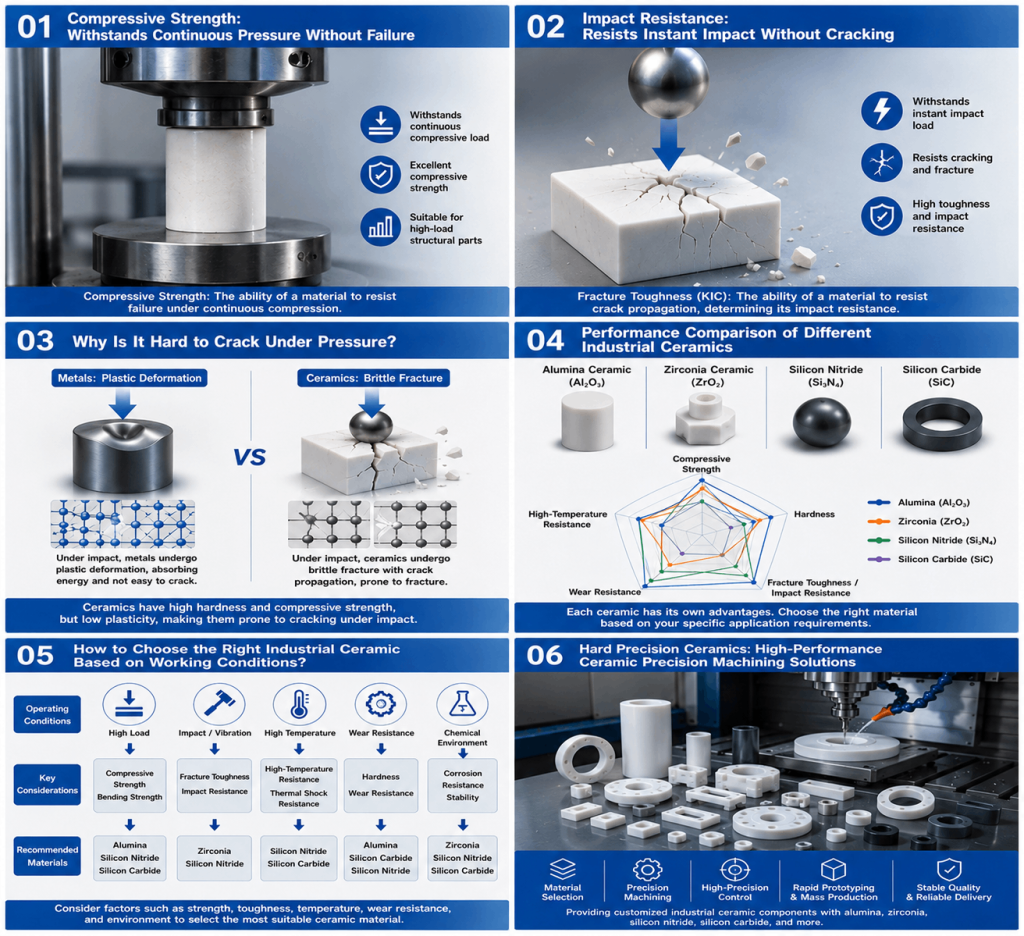
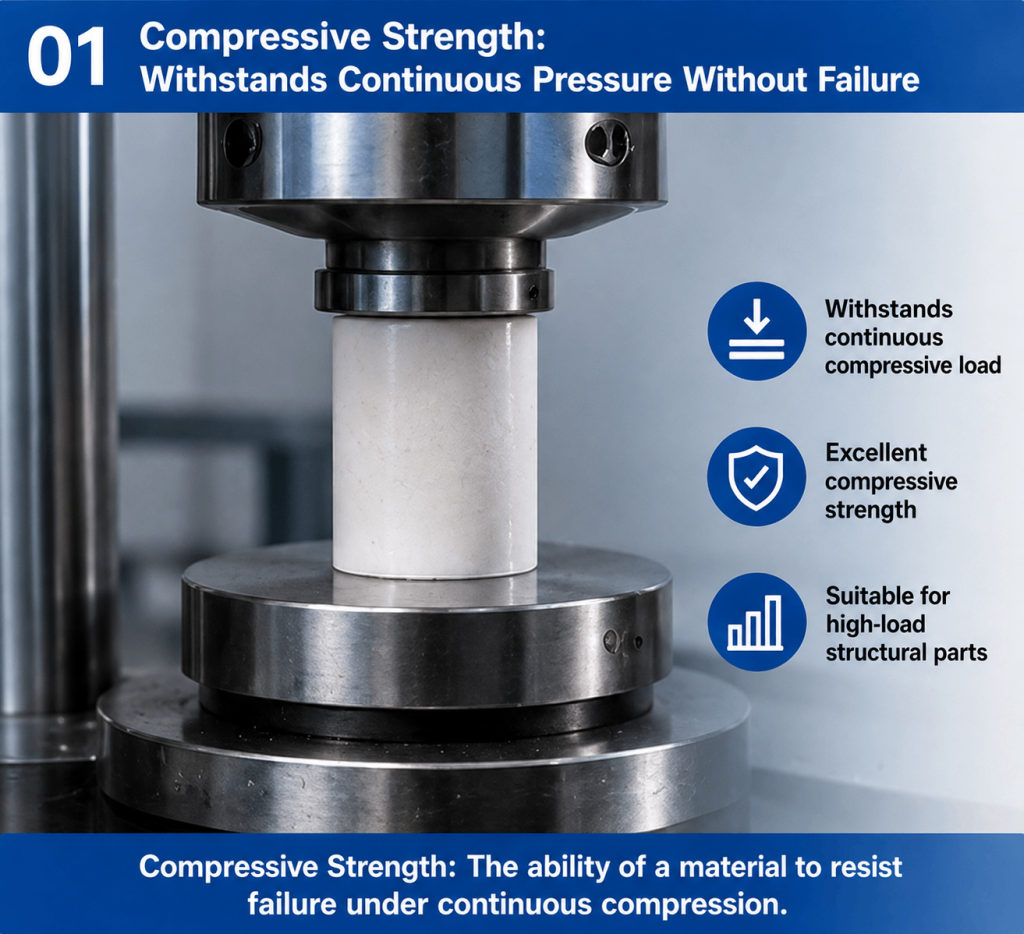
Compressive strength refers to a material’s ability to resist failure when subjected to sustained compressive loads.
For example, ceramic plungers and ceramic supports are subjected to continuous pressure during operation. If the material can withstand a large compressive load without cracking, it indicates good compressive strength.
Common indicators include:
Compressive strength, unit: MPa.
Industrial ceramics typically possess very high compressive strength, making them suitable for:
Ceramic plungers
Supporting structural components
Wear-resistant parts
Buskets
Clamping components
High-load structural components
Simply put: compressive strength primarily addresses “how much pressure it can withstand”.
2. What is the impact resistance of industrial ceramics?
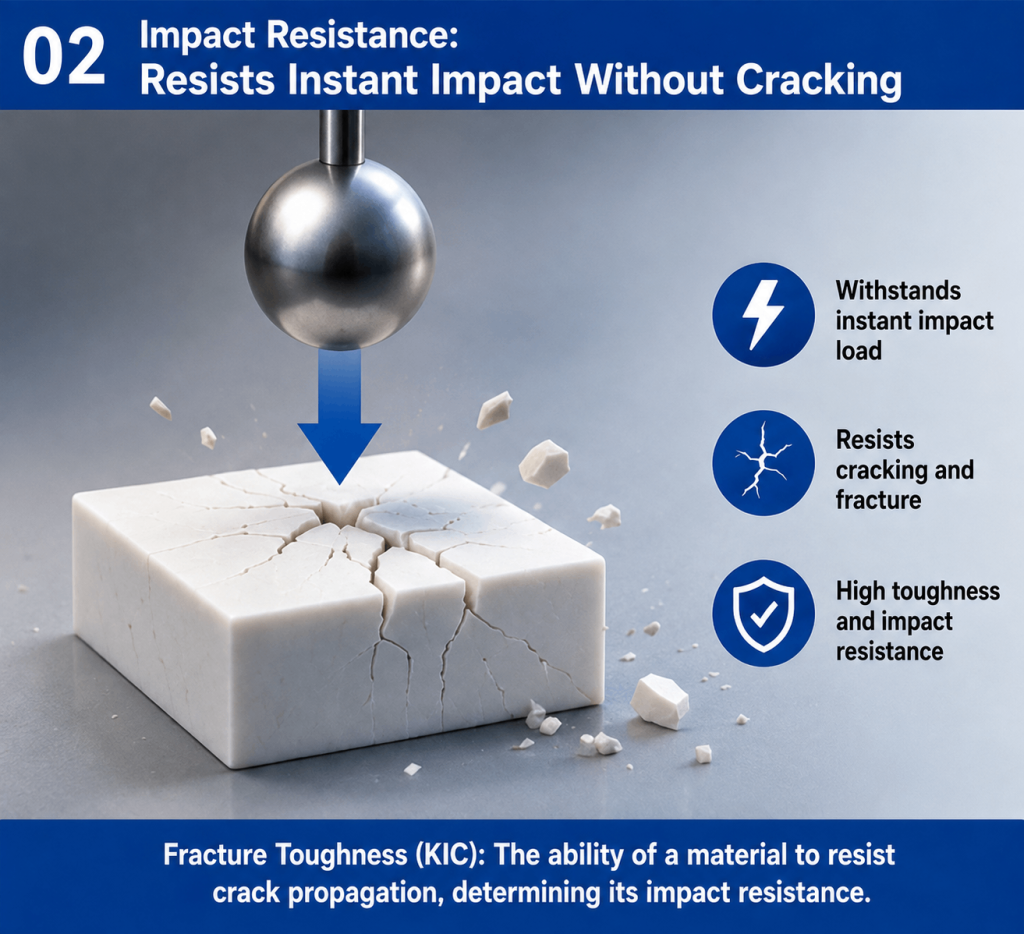
Impact resistance primarily refers to a material’s ability to resist the initiation and propagation of cracks when subjected to instantaneous, rapid impact loads.
For example, a ceramic part:
Under normal circumstances, it can withstand significant pressure, but if suddenly impacted, it may still experience:
Chip chipping
Cracks
Fracturing
Fragmentation
Therefore:
High compressive strength ≠ high impact resistance.
When assessing the impact resistance of ceramics, in addition to flexural strength, the following should be considered:
Fracture toughness (KIC)
Fracture toughness reflects a material’s ability to resist crack propagation.
Generally speaking, the higher the fracture toughness, the less likely the material is to fracture rapidly after a crack appears.
3. Why is it that ceramics, despite their high compressive strength, may not be impact-resistant?
This is related to the material properties of ceramics.
Ceramics have a stable crystal structure and strong chemical bonds, thus possessing:
High hardness
High compressive strength
High wear resistance
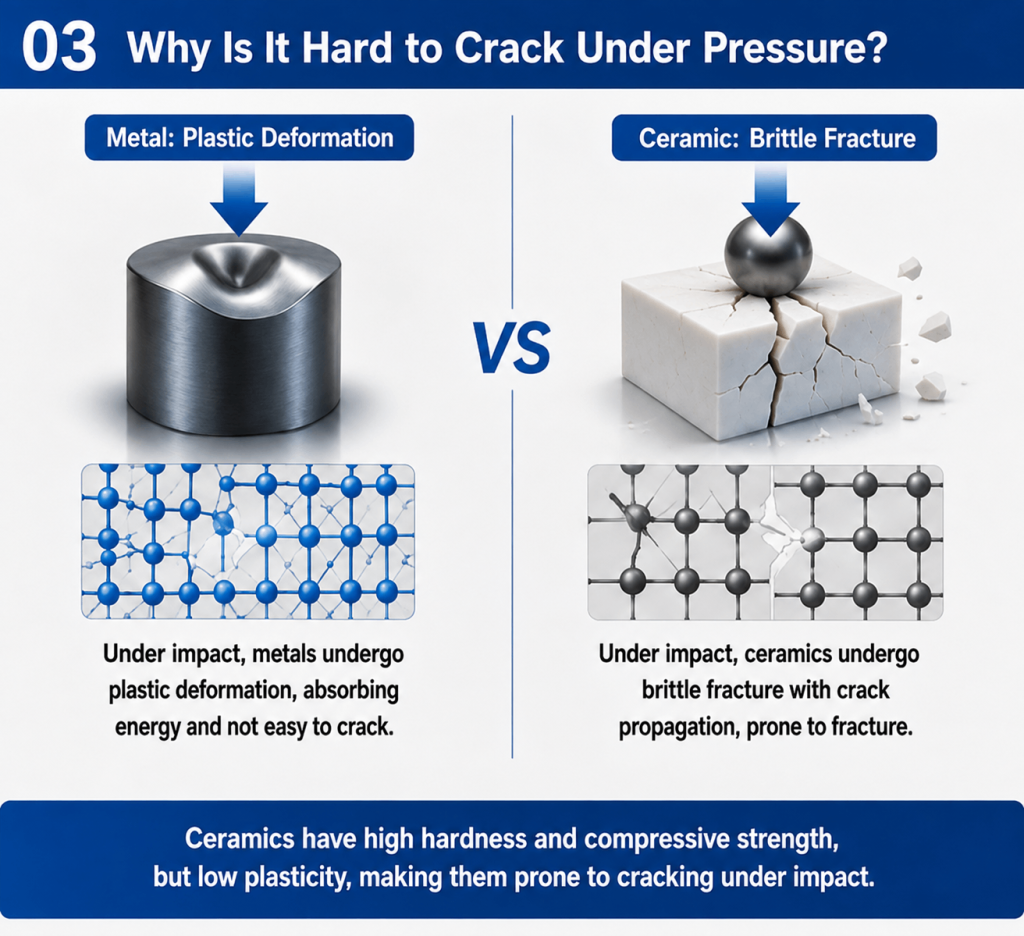
However, ceramics generally have relatively weak plastic deformation capabilities.
When metals are impacted, they can absorb impact energy through a certain degree of plastic deformation.
However, ceramics, when subjected to a sudden impact, typically cannot undergo significant plastic deformation like metals.
If localized stress concentration occurs, microcracks may form and propagate.
Therefore:
The “hardness” of ceramics means they are not easily dented or worn, but it does not mean they will not crack.
This is also an important reason why hardness and compressive strength cannot be considered alone when selecting industrial ceramics.
4. What are the differences in impact resistance among different industrial ceramics?
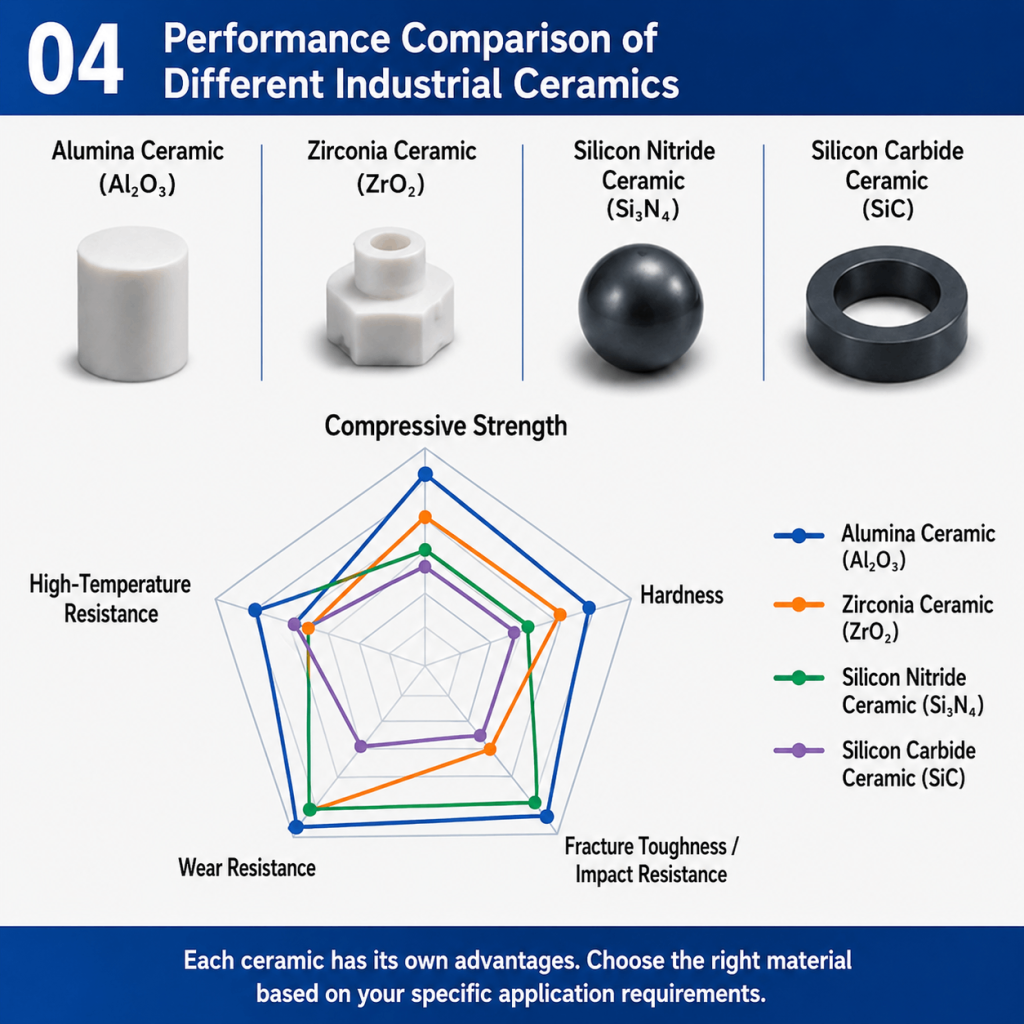
| Material | Pressure resistance | hardness | Toughness/Impact Resistance | Main advantages |
|---|---|---|---|---|
| alumina ceramics | ★★★★★ | ★★★★★ | ★★★ | High cost performance, wear-resistant, and insulating. |
| Zirconia ceramics | ★★★★★ | ★★★★ | ★★★★★ | High toughness and fracture resistance |
| silicon nitride ceramics | ★★★★★ | ★★★★★ | ★★★★ | High strength, thermal shock resistant |
| silicon carbide ceramics | ★★★★★ | ★★★★★ | ★★★ | High hardness and high temperature resistance |
| Aluminum nitride ceramics | ★★★★ | ★★★ | ★★★ | High thermal conductivity and insulation |
Alumina ceramics are better suited for:
wear-resistant, insulating, and cost-effective applications.
Zirconium oxide ceramics are better suited for:
high toughness, impact resistance, and precision structural components.
Silicon nitride ceramics are better suited for:
high-speed, high-temperature, and thermal shock resistant applications.
Therefore, there is no absolute answer to “which ceramic is the best at resisting impact”; the key is to consider the specific application environment.
For more performance parameters of different ceramic materials, please click to view “Comparison of Precision Ceramic Materials”.
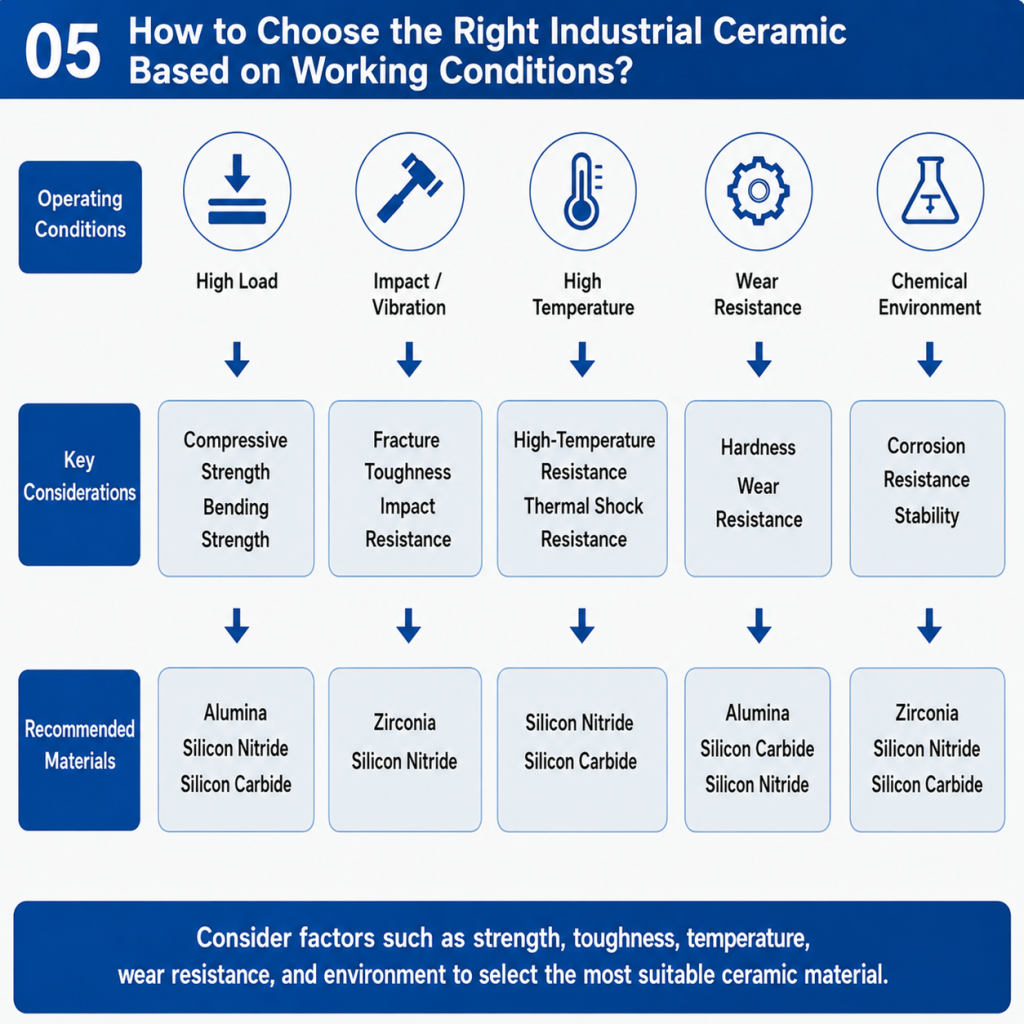
5. How should industrial ceramics be selected based on their resistance to pressure and impact?
When selecting materials, you cannot only look at one parameter.
If it mainly bears continuous compressive load
Key focus areas:
Compressive strength + Bending strength
Examples:
Ceramic plungers
Support components
Clamping components
If frequent impacts and vibrations occur
focus on:
Fracture toughness + Bending strength + Actual impact conditions
For example:
High-speed moving parts
Valve cores
Precision structural components
If both high temperature and impact are present,
the following should also be considered:
thermal shock resistance
In this case, silicon nitride ceramics usually have a significant advantage.
If wear resistance and cost are the primary considerations
This should be given priority.
Alumina ceramics.
Therefore, the truly professional way to select industrial ceramics should be:
A comprehensive assessment based on strength, hardness, toughness, wear resistance, temperature, chemical environment, and processing precision.
In conclusion: Pressure resistance ≠ Impact resistance; choosing the right materials is more important than pursuing high strength.
Although the compressive strength and impact resistance of industrial ceramics both belong to mechanical properties, they address two different issues.
Compression resistance: This refers to the amount of compressive load the material can withstand.
Impact resistance: This refers to the material’s ability to resist cracking and fracture after being subjected to a sudden impact.
Therefore, when selecting industrial ceramics, one should not only look at whether the compressive strength is high, but also make a comprehensive judgment based on hardness, fracture toughness, bending strength, thermal shock resistance and the actual working environment.
There is no absolutely best industrial ceramic, only materials that are more suitable for specific working conditions.
If you have specific drawings, dimensions, loads, speeds, operating temperatures, or operating environments for ceramic parts, you can select more suitable alumina, zirconium oxide, silicon nitride, aluminum nitride, or silicon carbide ceramic materials based on the actual working conditions. From material selection to precision machining, we provide complete industrial ceramic solutions for your products.
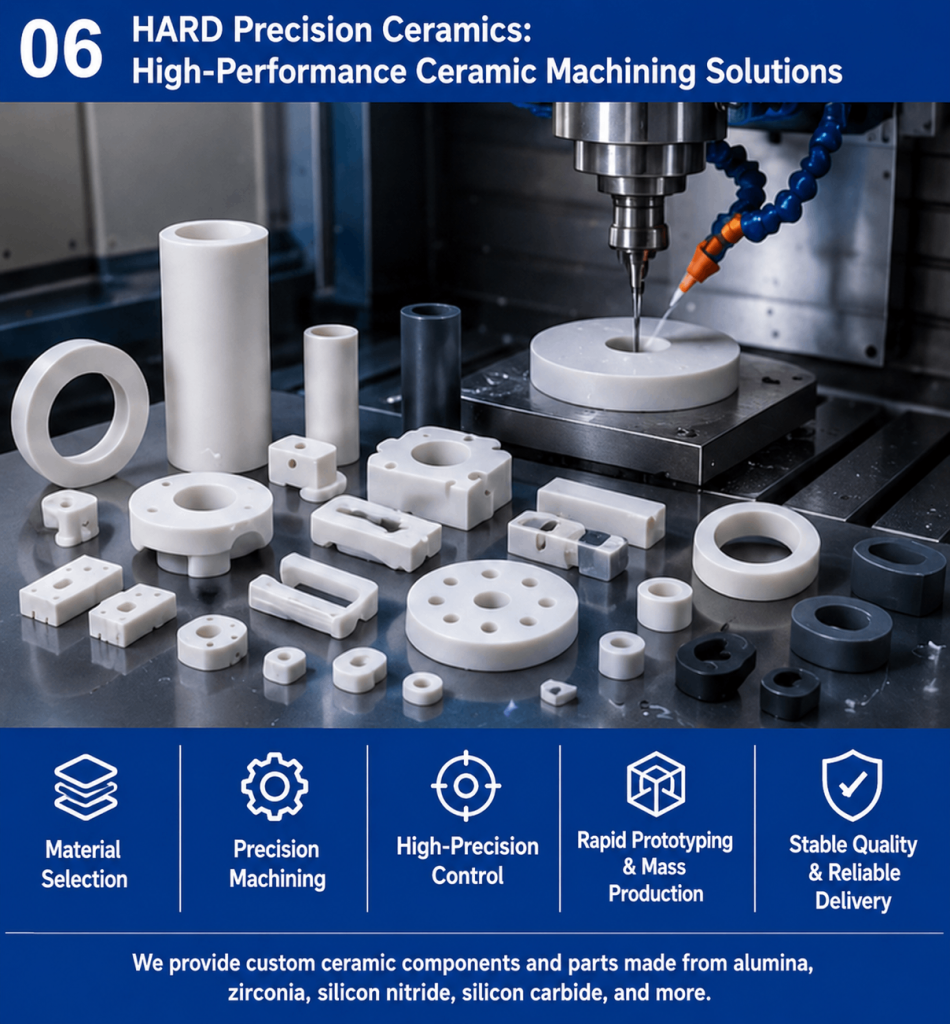
Dongguan Haikun New Materials Co., Ltd.
Specializes in high-performance industrial ceramic materials and precision ceramic parts processing, and can provide material selection and customized processing services according to customers’ actual working conditions.
Alumina ceramics
Suitable for:
Insulation, wear resistance, high temperature, and cost-effective applications.
Zirconia ceramics
Suitable for:
High-toughness, impact resistance, and wear-resistant precision structural components.
Silicon nitride ceramics
Suitable for:
High-speed, high-temperature, thermal shock resistant, and high-reliability structural components.
Aluminum nitride ceramics
Suitable for:
High thermal conductivity, high insulation electronic and power devices.
Silicon carbide ceramics
Suitable for:
High-temperature, high-hardness, and high-wear-resistance applications.
We also provide:
CNC precision machining
Precision grinding
Surface grinding
Mirror polishing
Laser cutting
Micro-hole machining
Irregular shape machining
Customization based on provided drawings
Small batch prototyping
Mass production
Relevant information