
information centre / Industry Information / What are the advantages and disadvantages of microcrystalline glass ceramics?
What are the advantages and disadvantages of microcrystalline glass ceramics?
Introduction
In the field of industrial ceramics, besides traditional engineering ceramics such as alumina ceramics, zirconia ceramics, and silicon nitride ceramics, a special material is attracting increasing attention due to its machinability, dimensional stability, and insulation properties—glass-ceramics. Among them, the representative Macor® machinable ceramic, with its characteristics of being “as easy to process as metal while possessing ceramic properties,” is widely used in high-precision fields such as semiconductors, vacuum equipment, aerospace, medical equipment, and laboratory instruments. So, what exactly are glass-ceramics? What are their advantages? And what are their disadvantages? This article will comprehensively analyze the characteristics and application value of glass-ceramics.
Quick Links
Contact Us
Live
E-mail:sales01@hkceramic.com
1. What is microcrystalline glass ceramic?
Microcrystalline glass-ceramics, also known as:
Microcrystalline glass
Machinable ceramics
Glass ceramics
English:
Glass Ceramic / Machinable Glass Ceramic
A novel inorganic non-metallic material formed through a special heat treatment process, resulting in a large number of uniform microcrystalline structures within a glass matrix.
It combines:
the processing properties of glass
the stable properties of ceramics
thus forming a unique material system.
Structural Characteristics of Microcrystalline Glass-Ceramics
Ordinary Glass:
Disordered internal structure, limited strength.
Traditional Ceramics:
High strength, but difficult to process after sintering.
Microcrystalline Glass-Ceramics:
Forms a uniform crystalline structure within a glass matrix, achieving improved performance.
Therefore, they possess the following characteristics:
✔ High dimensional stability
✔ Low thermal expansion
✔ Excellent insulation
✔ Easy precision machining
and other features.
2. What are the advantages of microcrystalline glass ceramics?
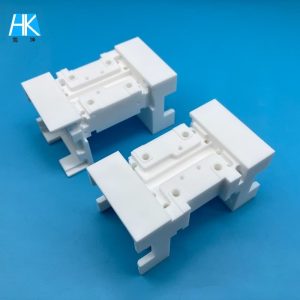
1. Biggest Advantage: Direct Machinability
This is the most significant characteristic that distinguishes microcrystalline glass ceramics from ordinary industrial ceramics.
Traditional Ceramics:
Extremely high hardness after sintering:
Difficult CNC machining
High machining costs
Prone to edge chipping
Typically requires:
Diamond grinding
Laser processing
Microcrystalline glass-ceramics:
Can be directly processed using ordinary equipment:
CNC machining centers, milling machines, drilling machines, lathes to:
✔ Drilling
✔ Milling
✔ Tapping
✔ Machining of irregular shapes
Therefore, they are particularly suitable for:
Product development stage
Small batch production
Complex structural parts
2. Excellent Electrical Insulation Properties
Microcrystalline glass ceramics possess excellent insulation properties (≥ 30KV/mm).
Typical Characteristics:
High resistivity
Low dielectric loss
Stable high-frequency performance
Therefore, they are suitable for:
High-voltage insulation components
RF equipment
Vacuum equipment
Semiconductor equipment
3. Low coefficient of thermal expansion and good dimensional stability. Microcrystalline glass-ceramics have a low coefficient of thermal expansion.
Advantages:
Small dimensional changes with temperature variations
High precision retention
Particularly suitable for:
Precision measuring equipment
Optical equipment
Semiconductor tooling fixtures
4. Corrosion Resistance and Low Outgassing Performance
In a vacuum environment, the amount of material outgassing affects equipment stability.
Microcrystalline glass-ceramics possess the following characteristics:
✔ Low volatility
✔ Good chemical stability
✔ Low environmental pollution
Therefore, they are used in:
Vacuum chamber components
Electron beam equipment
Semiconductor manufacturing equipment
5. Suitable for rapid development of complex structures
Since no complex post-sintering processing is required, microcrystalline glass-ceramics are particularly suitable for:
Non-standard parts
Small batch products
Experimental verification parts
Compared to traditional ceramics:
It can significantly shorten the processing cycle.
3. What are the disadvantages of microcrystalline glass ceramics?
While microcrystalline glass-ceramics offer many advantages, they are not a panacea.
There are also some limitations in practical applications.
1. Lower mechanical strength than high-performance structural ceramics
This is the biggest drawback of microcrystalline glass ceramics.
Compared to:
Alumina ceramics
Zirconium oxide ceramics
Silicon nitride ceramics
Its:
Lower flexural strength
Weaker impact resistance
Therefore, it is not suitable for:
❌ High impact loads
❌ High-strength load-bearing structures
❌ Heavy-duty wear-resistant parts
2. Moderate Wear Resistance
Although microcrystalline glass ceramics have high hardness, their wear resistance still lags behind:
alumina ceramics
zirconia ceramics
Long-term use is not recommended for:
high-speed friction
high-wear environments
3. Limited Maximum Operating Temperature
Microcrystalline glass-ceramics typically operate at a temperature of:
around 800℃.
Compared to:
| Material | Operating temperature |
|---|---|
| alumina ceramics | Around 1600℃ |
| silicon nitride ceramics | Around 1200℃ |
| silicon carbide ceramics | Around 1600℃ |
| Microcrystalline glass ceramics | Approximately 800℃ |
Therefore, it is not suitable for extreme high-temperature environments.
4. Higher Material Costs
Although processing costs are low, due to:
Special raw materials
High manufacturing process requirements
Material prices are generally higher than ordinary glass and some alumina ceramics.
However, for products requiring:
Small batches, high precision, and rapid delivery, the overall cost is actually more advantageous.
4. What are the differences between microcrystalline glass ceramics and alumina ceramics?
| Comparison Projects | Microcrystalline glass ceramics | alumina ceramics |
|---|---|---|
| Processing performance | ★★★★★ | ★★★ |
| strength | ★★★ | ★★★★★ |
| abrasion resistance | ★★★ | ★★★★★ |
| insulation | ★★★★★ | ★★★★★ |
| High temperature performance | ★★★ | ★★★★★ |
| Small batch processing | ★★★★★ | ★★★ |
| Mass application | ★★★ | ★★★★★ |
In short:
Microcrystalline glass ceramics have the advantage of being “easy to process”; alumina ceramics have the advantage of “stable performance”.
5. Main application areas of microcrystalline glass ceramics
Semiconductor Industry
Applications:
Precision jigs
Insulating supports
Vacuum equipment parts
Wafer processing auxiliary parts
Advantages:
High cleanliness
Low pollution
Easy to process
Vacuum Equipment
Applications:
Vacuum Insulators
Electrode Supports
Structural Components
Aerospace
Applications:
Precision test components
Insulating structural components
Sensor assemblies
Experimental Instruments
Applications:
Optical Platform
Positioning Fixture
Precision Support
6. How to choose microcrystalline glass ceramics?
If your product requires:
✅ Complex structure
✅ Rapid processing
✅ Small batch production
✅ High insulation requirements
✅ High dimensional stability
Recommended:
Macor (Microcrystalline Glass-Ceramic)
If your needs are:
✅ High wear resistance
✅ High strength
✅ Long lifespan
✅ High temperature environment
Recommended:
Alumina / Zirconia / Silicon nitride ceramics
Conclusion: What is the value of microcrystalline glass-ceramics?
While microcrystalline glass-ceramics are not the “strongest ceramics” in the traditional sense, they solve a crucial problem in the industrial field:
How to achieve high-performance ceramics while simultaneously possessing excellent machinability.
They combine the ease of processing glass with the stability of ceramics, making them an important material in precision manufacturing, semiconductor equipment, and scientific research.
For R&D, small-batch, high-precision parts, microcrystalline glass-ceramics are often a highly valuable choice.
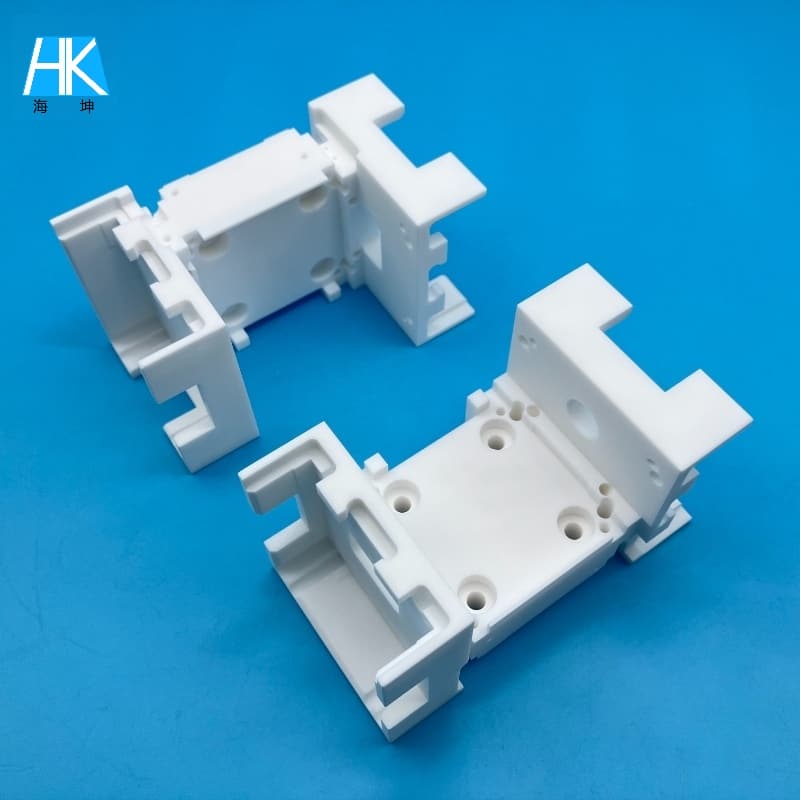
Dongguan Haikun New Materials Co., Ltd.
Focuses on the R&D and precision machining of high-performance industrial ceramics, and provides:
Microcrystalline glass-ceramic products
Macor-processable ceramic parts
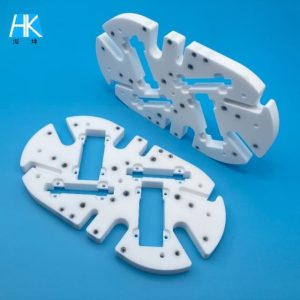
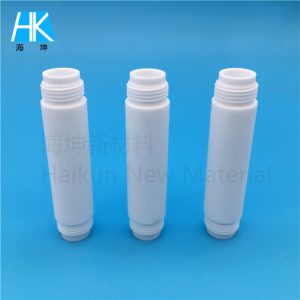
Microcrystalline glass-ceramic tubes
Microcrystalline glass-ceramic plates
Microcrystalline glass-ceramic structural components
Processing capabilities
✔ CNC Precision Machining
✔ Drilling, Milling, and Tapping
✔ Customized Irregular-Shaped Parts
✔ Precision Dimension Control
✔ Small Batch Rapid Prototyping
Also offering:
High-performance industrial ceramic solutions including:
Alumina ceramics
Zirconium oxide ceramics
Silicon nitride ceramics
Aluminum nitride ceramics
From material selection to precision machining, we provide professional customized services for the semiconductor, new energy, medical, automation, and high-end equipment industries.
Relevant information