
information centre / Industry Information / What are the differences between Macor ceramics and alumina ceramics?
What are the differences between Macor ceramics and alumina ceramics?
Introduction
In the field of precision ceramics, both Macor machinable ceramics and alumina ceramics (Al₂O₃) are widely used industrial ceramic materials. Many customers encounter these questions when selecting materials: What are the differences between Macor ceramics and alumina ceramics? Which material is easier to process? Which is more suitable for my product? In reality, both materials have their advantages, and there is no absolute superiority or inferiority; the key lies in whether they match the application scenario. This article will provide a comprehensive comparison from the aspects of material properties, processing methods, performance parameters, and application fields.
Quick Links
Contact Us
Live
E-mail:sales01@hkceramic.com
1. What is Macor ceramics?
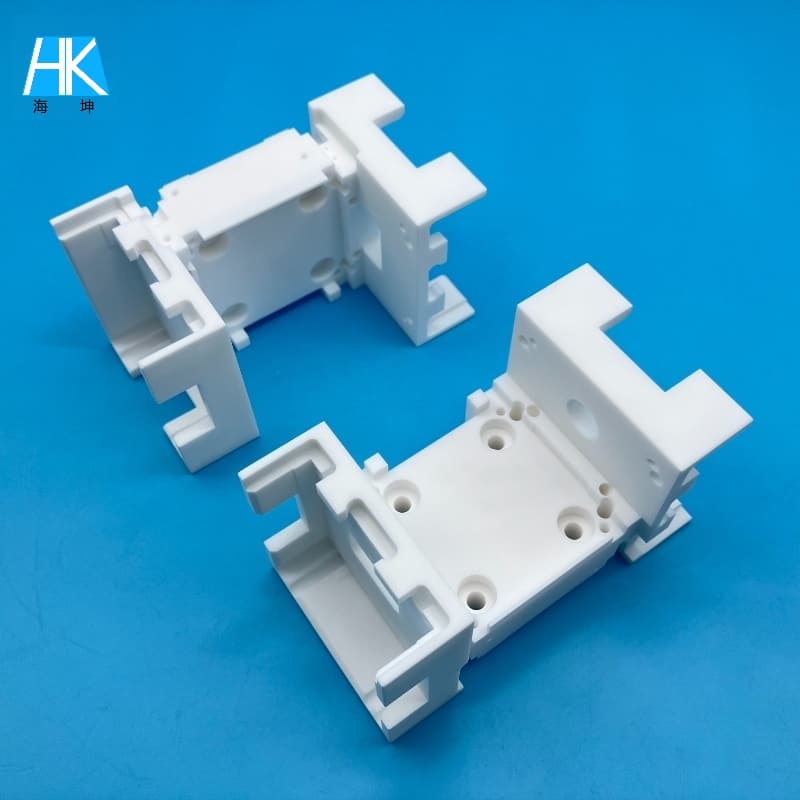
Macor ceramics, also known as:
machinable ceramics
microcrystalline glass-ceramics
is a high-performance engineering ceramic material composed of mica crystals and a glass phase.
Its most prominent feature is:
No grinding process after sintering is required; cutting can be performed directly using ordinary metal processing equipment.
Therefore, it is widely used in:
Semiconductor equipment
Vacuum equipment
Medical devices
Laboratory instruments
Aerospace
and other fields.
2. What are alumina ceramics?
Alumina ceramics are among the most widely used industrial ceramics.
Main purities include:
95% alumina
96% alumina
99% alumina
99.5%, 99.7%, 99.8%, 99.9% alumina
Characteristics include:
High hardness
High wear resistance
High insulation
Corrosion resistance
High temperature resistance
High cost-effectiveness
Widely used in:
Semiconductor equipment
New energy vehicles
Power electronics
Automation equipment
Precision machinery
and other industries.
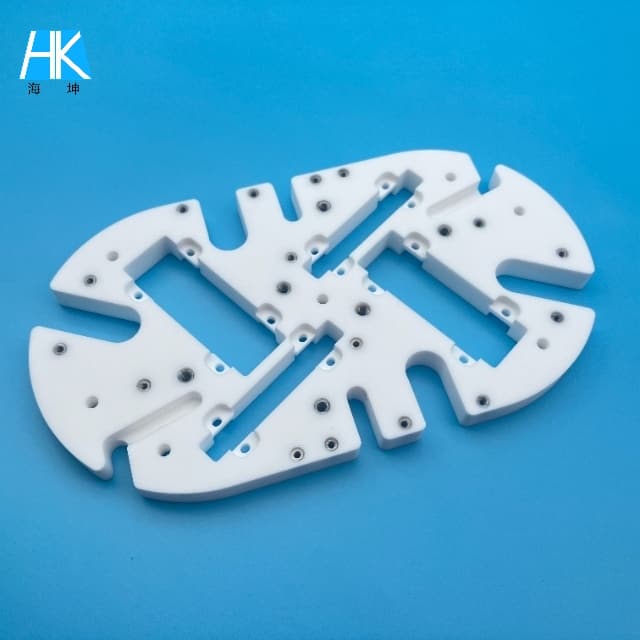
3. Performance Comparison of Macor Ceramics and Alumina Ceramics
| Performance items | Macor Machinable Ceramics | alumina ceramics |
|---|---|---|
| Density (g/cm³) | 2.5~2.6 | 3.7~3.9 |
| Operating temperature | ≤800℃ | ≤1650℃ |
| Thermal conductivity (W/m·K) | 1.4~1.7 | 20~30 |
| Bending strength (MPa) | 90~110 | 300~330 |
| Vickers hardness (HV) | 250 | 1600 |
| Electrical insulation performance | excellent | excellent |
| wear resistance | generally | Excellent |
| Corrosion resistance | good | Excellent |
| Processing difficulty | Very easy to process | High processing difficulty |
In terms of overall performance:
are significantly superior to Macor ceramics.
However, in terms of processing:
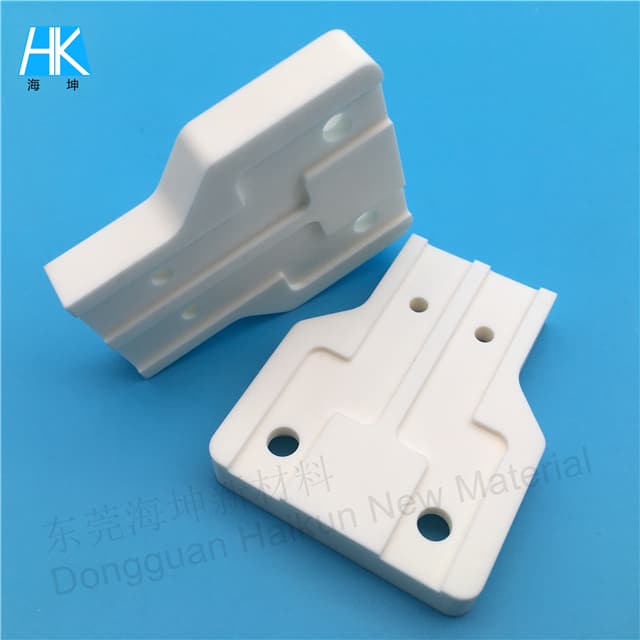
has overwhelming advantages.
4. The biggest difference: The processing methods are completely different.
Macor’s biggest advantage is that:
it can still be directly machined after sintering.
It can be used with:
CNC machining centers, CNC lathes, drilling machines, milling machines, tapping machines to directly complete:
drilling, tapping, milling, and machining of irregular structures without diamond grinding.
It is especially suitable for:
small batch products, R&D samples, and rapid prototyping projects.
Alumina ceramics – high-hardness precision grinding
Alumina has extremely high hardness.
After sintering, it can only be processed using:
diamond wheel grinding
precision surface grinding
internal and external cylindrical grinding
laser processing.
Therefore:
the processing cycle is relatively long.
However, it yields:
higher precision
higher wear resistance
longer service life
5. What applications are Macor ceramics and alumina ceramics suitable for?
R&D prototyping
Frequent product design revisions.
Small batch production
No mold making required.
Complex irregular structures
Directly machinable.
Vacuum equipment
Low outgassing rate.
Laboratory equipment
Easy to process.
Common products:
Vacuum insulation components
Optical supports
Probe fixtures
Precision jigs
Alumina ceramics are suitable for:
High-wear-resistant parts
Long-term friction conditions
High-temperature equipment
Long-term high-temperature operation
Electronic insulating components
High-voltage insulation environments
Semiconductor equipment
High cleanliness requirements
Automation equipment
Long-life structural components
Common products:
Ceramic substrates
Ceramic guide rails
Ceramic nozzles
Ceramic bushings
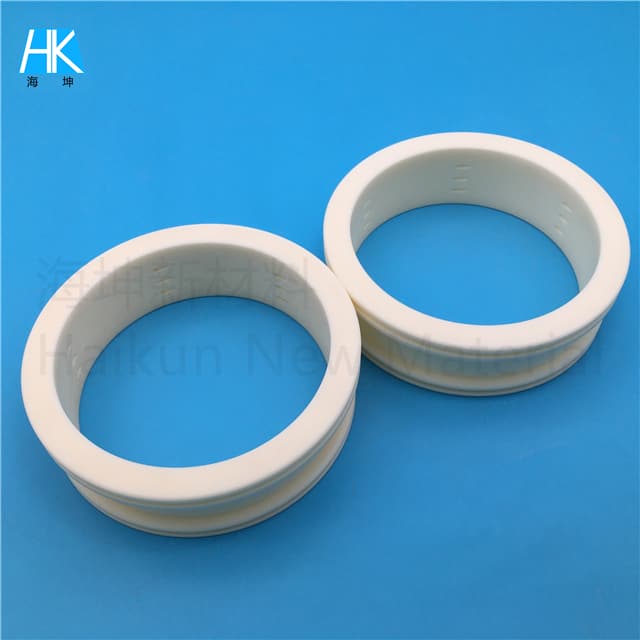
Ceramic insulating rings
6. How to choose between these two materials
If your needs are:
✔ Quick prototyping
✔ Small batch production
✔ Complex structure machining
✔ Need for threaded holes or irregular holes
recommend:
Macor Machinable Ceramics
If your needs are:
✔ High wear resistance
✔ High strength
✔ Long lifespan
✔ High temperature environment
✔ High-volume application
Recommended:
alumina ceramics
Which materials will the industrial sector favor in the future?
From a market application perspective:
Alumina ceramics remain one of the most widely used materials in the industrial ceramics field.
The reasons are:
Low cost, balanced performance, mature processing technology, and wide applicability.
Macor ceramics are more often used in:
Research and development testing, small-batch customization, high-precision instruments, and other specialized fields.
therefore:
Macor ceramics emphasize ease of processing, while alumina ceramics emphasize comprehensive performance and industrial application value.
Although both Macor ceramics and alumina ceramics belong to the category of engineering ceramic materials, their design philosophies are completely different.
Macor ceramics address the problem of “difficult processing”;
Alumina ceramics address the problem of “high performance”.
In actual projects, materials should be selected comprehensively based on the usage environment, structural complexity, processing costs, and lifespan requirements to achieve the best cost-effectiveness.
Dongguan Haikun New Materials Co., Ltd.
We professionally provide:
Support:
✔ Custom processing based on provided drawings
✔ CNC precision machining
✔ Laser cutting for micro-hole processing
✔ Surface grinding and mirror polishing
✔ Small batch prototyping and mass production
Providing professional industrial ceramic solutions for the semiconductor, new energy, medical equipment, automation, and high-end equipment manufacturing industries.
Relevant information