
information centre / Industry Information / What makes alumina ceramics corrosion resistant? Why are they so widely used?
What makes alumina ceramics corrosion resistant? Why are they so widely used?
Introduction
In industrial manufacturing, chemical equipment, pump and valve components, and precision machinery, corrosion resistance is one of the most important properties when selecting materials. Among numerous industrial ceramic materials, alumina ceramics (Al₂O₃ ceramics) have become an ideal alternative to metals and polymer materials due to their extremely strong corrosion resistance. So, why do alumina ceramics achieve such outstanding corrosion resistance? This article will provide a professional interpretation from three perspectives: material structure, chemical properties, and application performance.
Quick Links
Contact Us
Live
E-mail:sales01@hkceramic.com
1.The Core Reasons for the Corrosion Resistance of Alumina Ceramics
1. Extremely stable chemical properties, not easily reacting with chemical media.
Alumina, with the chemical formula Al₂O₃, is itself a highly stable oxide.
It does not react chemically with most acids, alkalis, and salts, thus exhibiting excellent performance in various corrosive environments:
Strong acid resistance (except for hydrofluoric acid HF)
Good alkali resistance
Completely inert in organic solvents
Not oxidized or hydrolyzed in humid environments
In summary: Alumina ceramics are essentially “final-state compounds,” with almost no room for further reaction, therefore they are not easily corroded.
2. Highly Dense Structure, Effectively Blocking Corrosive Media Penetration
After sintering, alumina ceramics possess extremely high density (3.7~3.85 g/cm³), with tightly packed grains and virtually no micropores allowing media penetration.
Advantages of the dense structure:
Liquids and gases cannot penetrate.
Corrosive ions cannot intrude into the internal structure.
Internal corrosion is less prone to pitting, crevice corrosion, and stress corrosion.
Compared to metallic materials, which are susceptible to localized corrosion due to grain boundaries, defects, or stress, the density of alumina ceramics prevents corrosion from occurring.
3. Non-conductive, rust-free, and free from electrochemical corrosion
Alumina is an insulator with extremely low conductivity, therefore it will not experience the following corrosion phenomena as metals:
Electrochemical corrosion
Galvanic corrosion
Current corrosion
This means that:
Even when exposed to charged liquids, electrolytes, or humid environments, alumina ceramics will not rust or be electrochemically corroded.
4. Strong high-temperature resistance and good thermal stability
Alumina has a melting point as high as 2050℃, exhibiting excellent heat resistance and resistance to hot corrosion.
At high temperatures, many metals oxidize, soften, or react with the medium, while alumina ceramics maintain a stable chemical structure.
This makes it ideal for:
High-temperature acid and alkaline environments
High-temperature molten metals
High-temperature gas corrosion environments
5. High hardness, wear-resistant and powder-free
Alumina ceramics have a hardness of up to 1600 HV.
Higher hardness means it is less susceptible to scratches or wear, and therefore less prone to accelerated corrosion due to surface damage.
For relevant material performance parameters, please refer to “Comparison of Precision Ceramic Material Properties“.
2. Typical applications of alumina ceramics in corrosive environments
Due to its dual advantages of corrosion resistance and wear resistance, alumina ceramics are widely used in the following industries:
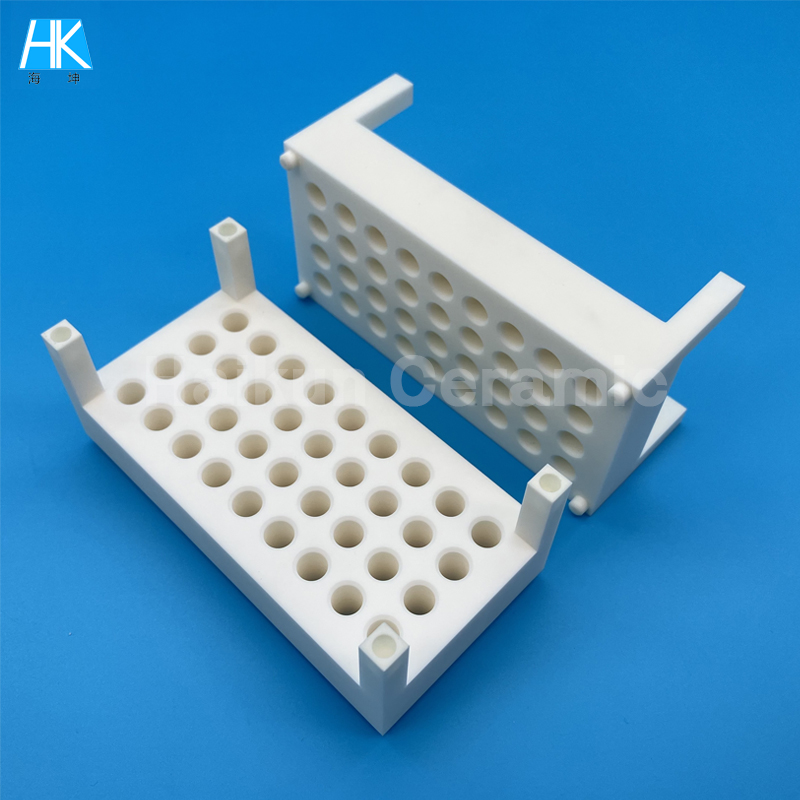
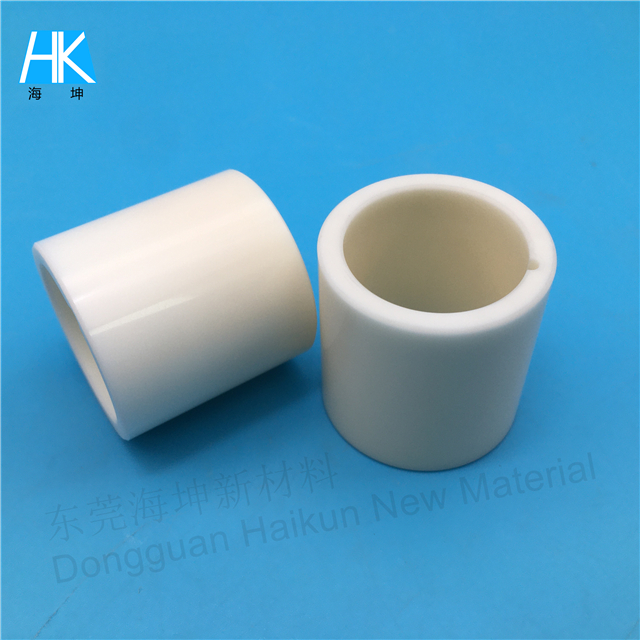
● Chemical equipment: pumps, valves, bushings, seals
Resistant to acids and alkalis, and solvents; will not leak or jam due to corrosion.
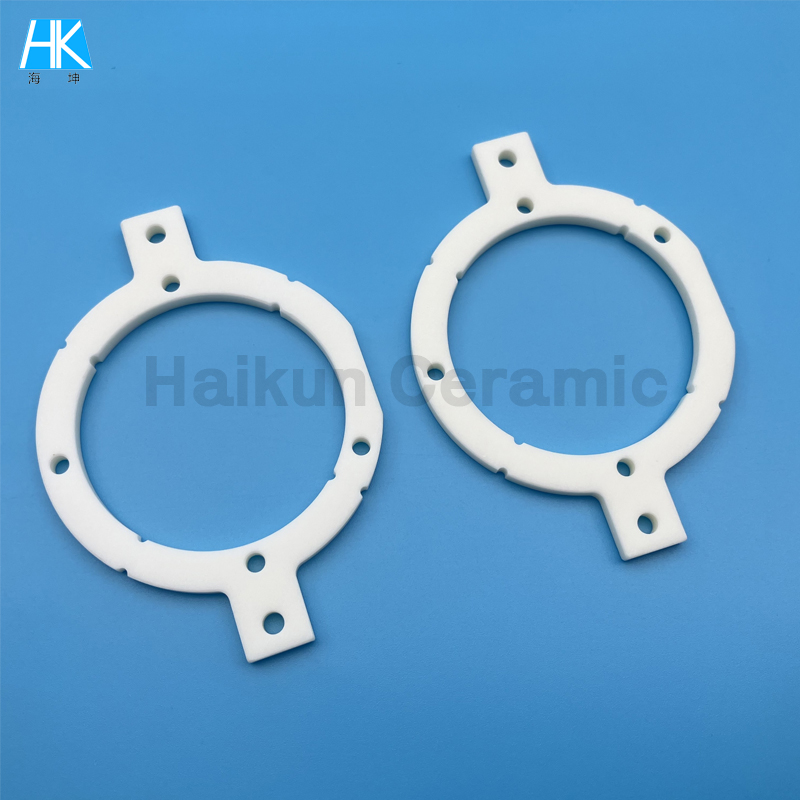
● Semiconductor and electronics industry: Fixtures, jigs, insulating components
Resistant to chemical cleaning solutions and will not be corroded by acidic gases.
● Medical Devices and Laboratory Equipment
They do not react with the human body or pharmaceutical solutions and do not release metal ions.
● Environmental Engineering: Desulfurization and Denitrification, Wastewater Treatment Equipment
Maintains a stable lifespan even under conditions of strong acids, strong alkalis, and particulate erosion.
3. Compared with metallic materials, alumina ceramics have more obvious advantages.
| Material | Acid resistance | Alkali resistance | rust | Electrochemical corrosion | Wear-resistant | High temperature stability |
|---|---|---|---|---|---|---|
| alumina ceramics | ★★★★★ | ★★★★☆ | Rust-free | Electrochemical corrosion | ★★★★★ | ★★★★★ |
| Stainless steel | ★★★☆☆ | ★★☆☆☆ | It will rust | Easy to produce | ★★☆☆☆ | ★★☆☆☆ |
| Engineering plastics | ★★★☆☆ | ★★☆☆☆ | Rust-free | none | ★☆☆☆☆ | ★☆☆☆☆ |
4. Conclusion: Choosing alumina ceramics means choosing long lifespan and high reliability.
The core reason why alumina ceramics are among the best corrosion-resistant materials is that:
Chemically stable
Dense structure
Non-conductive, rust-resistant
High temperature resistant
High hardness, wear-resistant
If your product is facing problems such as acid and alkali corrosion, liquid erosion, easy wear, or high temperature corrosion…
Alumina ceramics may be the most worthwhile upgrade solution.
Relevant information