
information centre / Ceramic material / Introduction of Aluminum Nitride Ceramic Materials
Introduction of Aluminum Nitride Ceramic Materials
Introduction
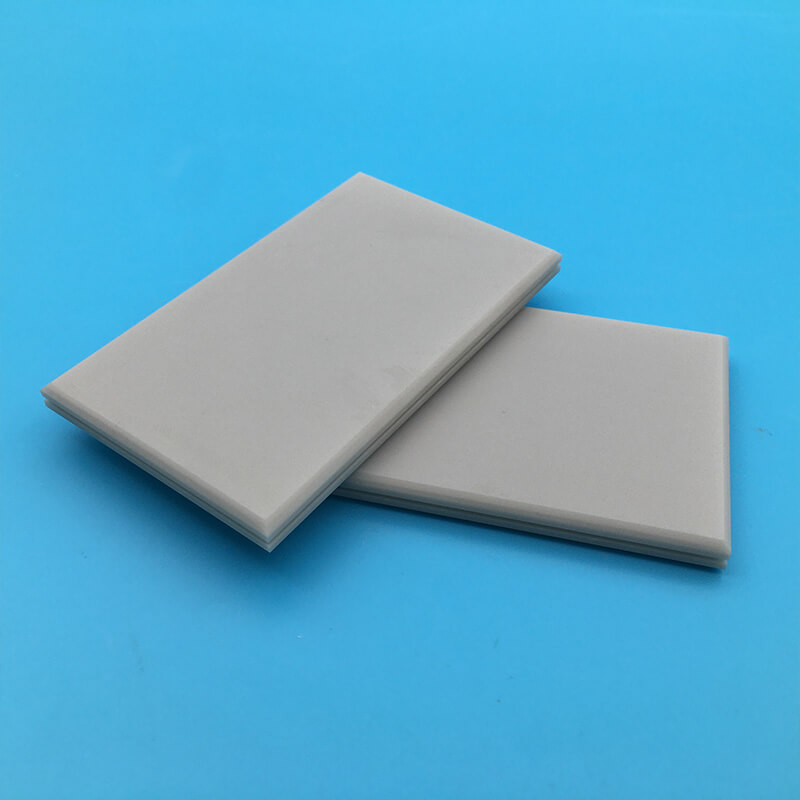
Aluminum nitride is a high-performance ceramic with excellent electrical insulation and thermal conductivity, ideal for heat dissipation in semiconductor processing equipment. Its plasma resistance and mechanical strength make it crucial in optoelectronics and high-temperature components.
Quick Links
Contact Us
Live
E-mail:sales01@hkceramic.com
Specifications|Support customization

| Plate material mm (L, H, and W can be selected as needed, customization supported) | ||||||||||||
| L | 3 | 5 | 8 | 10 | 12 | 15 | 18 | 20 | 22 | 25 | 28 | More (Customizable) |
| W*H | 100*100 | 90*140 | 95*145 | 150*150 | 160*160 | 122*290 | 110*275 | More (Customizable) | ||||
| Rod material mm (W, Ø can be selected as needed, customization supported) | ||||||||||||
| Ø | 0.5 | 0.8 | 0.9 | 1 | 1.5 | 2 | 2.5 | 3 | 3.5 | 4 | 4.5 | More (Customizable) |
| W | 60 | 100 | 120 | 200 | More (Customizable) | |||||||
Features
Aluminum nitride (Aluminum Nitride, AlN) is an advanced ceramic material highly valued in high-tech industries for its excellent thermal conductivity and electrical insulation. Aluminum nitride also boasts high mechanical strength and stable chemical properties, making it an ideal choice for electronics and industrial applications.
1. Excellent Thermal Conductivity and Electrical Insulation
Aluminum nitride combines very high thermal conductivity with excellent electrical insulation, making it highly valuable in applications that require efficient heat dissipation alongside electrical isolation.
- Efficient Thermal Management Solutions: Aluminum nitride’s high thermal conductivity makes it an ideal heat dissipation material for high-performance electronic devices such as power semiconductors, high-density integrated circuits, and high-frequency electronic components. These applications often require materials to rapidly and effectively dissipate heat to prevent performance degradation or damage due to overheating.
- Electrical Applications: While maintaining high thermal conductivity, aluminum nitride also exhibits outstanding electrical insulation. This is crucial for insulation components in applications like power conversion equipment and high-voltage electrical applications, where materials need to efficiently transfer heat without conducting electricity.
2. Thermal Expansion Coefficient Matching Silicon and Excellent Plasma Resistance
Aluminum nitride’s thermal expansion coefficient closely matches that of silicon, a critical feature along with its plasma resistance, making it particularly important in semiconductor manufacturing.
- Semiconductor Manufacturing: Due to its thermal expansion coefficient matching silicon, aluminum nitride minimizes thermal stresses caused by temperature variations when used as substrates or thermal interface materials in semiconductor devices. This is essential for enhancing the reliability and performance of semiconductor devices.
- Plasma Resistance: During semiconductor processing, components often endure harsh plasma environments that can corrode or damage weaker materials. Aluminum nitride’s excellent plasma resistance allows it to maintain stability in these conditions, preserving both performance and structural integrity.
These characteristics of aluminum nitride underscore its critical importance in modern high-tech fields, particularly in high-performance electronic devices and semiconductor manufacturing. Its exceptional physical properties not only enhance equipment performance but also extend product longevity, providing reliable material solutions for a variety of demanding industrial applications.
Primary characteristics
| Type | Unit | Aluminum Nitride |
| Material | \ | ALN |
| Colour | \ | Gray |
| Density | g/cm3 | 3.3 |
Mechanical properties
| Type | Unit | Aluminum Nitride |
| Flexural Strength(20℃) | Mpa | 470 |
| Compressive Strength(20℃) | Mpa | 2100 |
| Modulus of Elastic(young)(20℃) | Gpa | 320 |
| Tracture Toughness(20℃) | MPam½ | 2.6 |
| Poi sion’s Ratio(20℃) | \ | 0.24 |
| Hardness HRA(20℃) | HRA | 87 |
| Vickers Hardness(HV1) | Gpa(kg/mm2) | 1122 |
| Rockwell Hardness(45N) | R45N | 78.5 |
Thermal properties
| Type | Unit | Aluminum Nitride |
| Thermal Expansion Coefficient | 10-6K-1 | 4.6 |
| Thermal Conductivity(20℃) | W/mk | 170 |
| Thermal Shock Resistance | △T.℃ | 400 |
| Specific Heat Capacity | J/g·k | 0.72 |
| Max working Temperature(In Oxidizing) | ℃ | 1000 |
Electrical properties
| Type | Unit | Aluminum Nitride |
| Vol une Resistivity at 20℃ | Ωcm | 2.75*1014 |
| Dielectric Strength | KV/mm | 17 |
| Dielectric Constant | \ | 8.38 |
| Dielectric LossAngle at 20℃,1MHz20℃ | tanδ | 3*10-3 |
*Values are typical material properties, actual values may vary due to product configuration and manufacturing process.
*For more details, please feel free to contact our company.
*For more details, please feel free to contact our company.
Other
Precision ceramic products
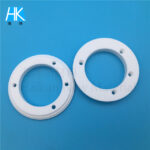
Macor Ceramic Rings
Material:Macor Ceramic
Describe:Macor Ceramic Rings are a type of advanced ceramic material with excellent machining properties. They can be cut, drilled, milled, etc. on conventional machining equipment (such as CNC, lathes, and drilling machines) without the need for special diamond tools. They are widely used in precision electronics, semiconductors, medical and high-temperature insulation fields.

Macor Ceramic Ferrule/Bush
Material:Macor Ceramic
Describe:Machinable ceramic Bush are a type of advanced ceramic material with excellent machining properties. They can be cut, drilled, milled, etc. on conventional machining equipment (such as CNC, lathes, and drilling machines) without the need for special diamond tools. They are widely used in precision electronics, semiconductors, medical and high-temperature insulation fields.
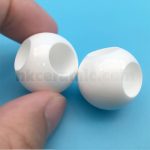
Zirconia ceramic valve core ball
Material:Zirconia Ceramics
Describe:Zirconia ceramic valve core balls offer precise fluid control with smooth surfaces and spherical designs. Their high hardness and strength ensure reliable performance under high pressure and flow conditions, supporting stable operation and longevity in fluid control systems.
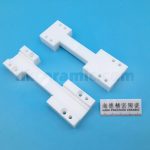
Zirconia ceramic terminal blocks
Material:Zirconia Ceramics
Describe:Customized zirconia ceramic terminal blocks, or terminal bases, feature intricate designs for precise electrical connections. Their high hardness and strength ensure stable performance under challenging conditions, enhancing equipment longevity.
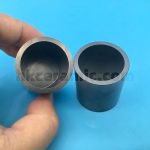
Small Silicon Nitride Ceramic Crucible
Material:Silicon Nitride Ceramics
Describe:Discover silicon nitride ceramic crucibles for high-temperature experiments and industrial melting processes. Known for their thermal stability, corrosion resistance, and durability, these crucibles ensure reliable performance in laboratory and industrial settings.
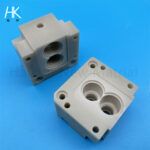
Aluminum Nitride Ceramic Heat Sink
Material:Aluminum Nitride Ceramics
Describe:Aluminum Nitride (AlN) ceramic heat dissipation components are advanced thermal management solutions designed for applications requiring high heat conductivity and electrical insulation. With a thermal conductivity of up to 170–200 W/m·K, AlN ceramics efficiently transfer heat away from sensitive electronic components, ensuring stable performance and extended service life. The material combines excellent thermal conductivity, low dielectric loss, and outstanding corrosion...