
information centre / Ceramic material, Industry Information / How can you distinguish between APC and PC ceramic ferrules?
How can you distinguish between APC and PC ceramic ferrules?
Introduction
In the field of optical communication and fiber optic connectors, ceramic ferrules are key components that determine the stability and insertion loss performance of fiber optic connections. However, in actual selection and use, many people encounter the question: what are the differences between APC and PC ceramic ferrules? And how can they be quickly distinguished? This article will systematically help you differentiate between APC and PC from four aspects: appearance, structure, optical performance, and application scenarios.
Quick Links
Contact Us
Live
E-mail:sales01@hkceramic.com
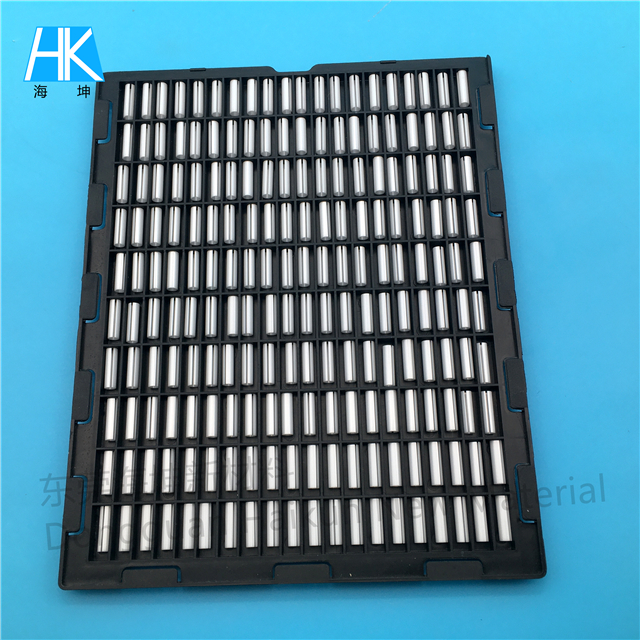
Specifications|Support customization

| Plate material mm (L, H, and W can be selected as needed, customization supported) | ||||||||||||
| L | 3 | 5 | 8 | 10 | 12 | 15 | 18 | 20 | 22 | 25 | 28 | More (Customizable) |
| W*H | 100*100 | 90*140 | 95*145 | 150*150 | 160*160 | 122*290 | 110*275 | More (Customizable) | ||||
| Rod material mm (W, Ø can be selected as needed, customization supported) | ||||||||||||
| Ø | 0.5 | 0.8 | 0.9 | 1 | 1.5 | 2 | 2.5 | 3 | 3.5 | 4 | 4.5 | More (Customizable) |
| W | 60 | 100 | 120 | 200 | More (Customizable) | |||||||
1. First, understand: What are PC and APC?
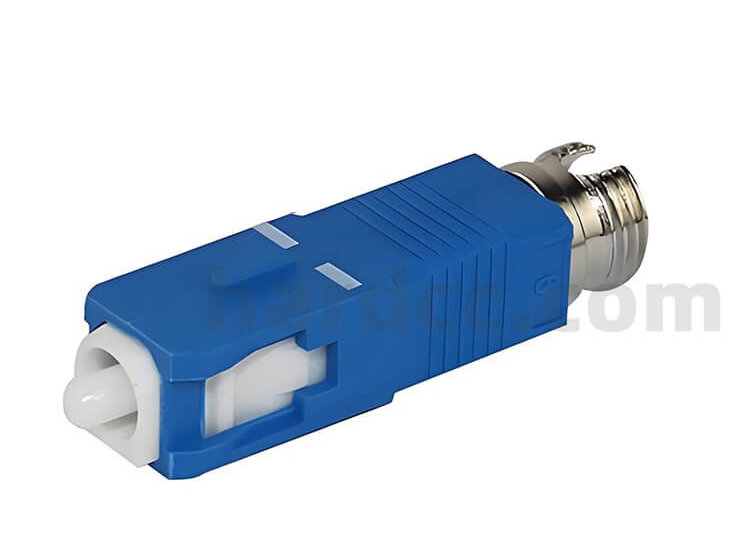
PC (Physical Contact)
The PC ferrule has a spherically polished end face. The optical fiber is located in the center of the ferrule, and the two fiber end faces make direct contact during connection to reduce reflections caused by air gaps.
End face angle: 0°
Common color: Blue
Earliest and most widely used application
APC (Angled Physical Contact)
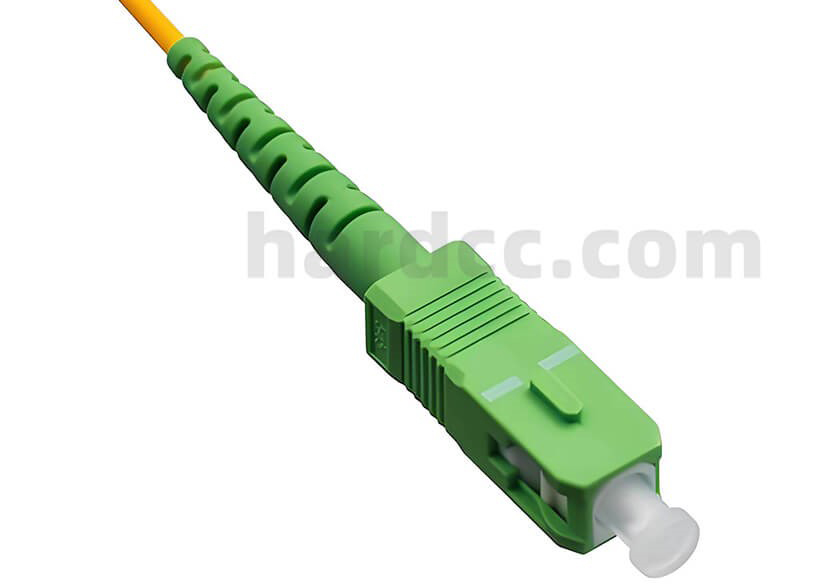
The APC ferrule is based on the PC ferrule, but with the end face polished into an angled structure, which deflects the reflected light away from the return path, thereby significantly reducing return loss.
End face angle: 8° (common)
Common color: Green
Primarily used in systems with extremely high return loss requirements
2. The most direct way to distinguish: look at the appearance.
① Check the angle of the ferrule end face (most reliable)
| type | end face shape | Is there an oblique angle? |
|---|---|---|
| PC | spherical | |
| APC | Spherical surface + inclined surface |
The APC insert end face is obviously “tilted”, while the PC is facing the plane.
② Check the connector color (quick judgment)
| type | Common colors |
|---|---|
| PC | blue |
| APC | green |
Colors are industry conventions, not absolute standards, but they are accurate in 90% of cases.
3. Differentiate APC from PC based on performance parameters
If appearance is a limitation, it can be judged by optical performance.
| parameter | PC ferrule | APC ferrule |
|---|---|---|
| Insertion loss | ≤0.3 dB | ≤0.3 dB |
| Return loss | ≥40 dB | ≥60 dB |
| Anti-reflective ability | generally | Extremely strong |
Return loss is the most critical difference between the two.
4. Different application scenarios are also an important basis for differentiation.
Common Applications of PC Flangers
General Fiber Optic Communication
Data Center Cabling
Enterprise Networks
Internal Connections of Optical Modules
Advantages:
Low Cost
High Versatility
Common Applications of APC Ferrules
FTTH (Fiber to the Home)
CATV (Cable Television) Networks
Long-Distance Optical Transmission
High-Sensitivity Optical Systems
Advantages:
Ultra-Low Return Loss
Excellent Anti-Reflection Performance
5. Why is zirconium oxide material commonly used for ceramic ferrules?
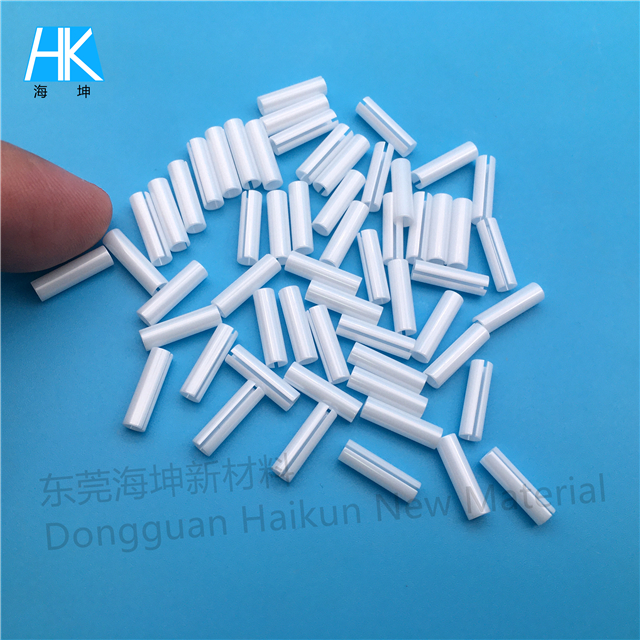
Whether it’s PC or APC, high-end fiber optic connectors almost exclusively use zirconia ceramic ferrules, for reasons including:
High hardness, stable pore size
Coefficient of thermal expansion matched with optical fiber
High-precision micro-hole processing capability
Mirror-level surface polishing achievable
The material of the ferrule itself determines the long-term stability of the connector.
6. Common Misconceptions and Reminders (Very Important) and Summary
Common Misconceptions
APC and PC adapters cannot be used interchangeably.
APC connectors cannot be forcibly inserted into a PC adapter.
Incorrect matching will result in: increased insertion loss, end face damage, and system instability.
How to quickly distinguish between APC and PC?
Just remember these 4 keywords:
Consider the angle, the color, the drawback, and the application.
Angled → APC
Green → High probability APC
High return loss requirement → APC
Ordinary communication → PC
Ceramic ferrule customization and processing services
Supports:
PC/APC ceramic ferrules
High-precision micro-hole machining
End face polishing and inspection
Batch consistency control
*Values are typical material properties, actual values may vary due to product configuration and manufacturing process.
*For more details, please feel free to contact our company.
*For more details, please feel free to contact our company.
Other
Precision ceramic products
High Precision Alumina Ceramic Components for Industrial Applications
Material:Alumina ceramics
Describe:High Precision Alumina Ceramic Components for Industrial Applications, also known as porous retaining rings, feature precise designs with drilled holes for secure connection. Their high hardness and strength ensure stability and durability under pressure, ideal for long-lasting equipment performance.
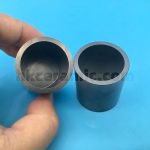
Small Silicon Nitride Ceramic Crucible
Material:Silicon Nitride Ceramics
Describe:Discover silicon nitride ceramic crucibles for high-temperature experiments and industrial melting processes. Known for their thermal stability, corrosion resistance, and durability, these crucibles ensure reliable performance in laboratory and industrial settings.
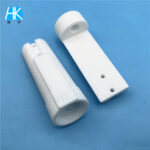
Machinable Ceramic Parts
Material:Macor Ceramic
Describe:Machinable ceramic Parts are a type of advanced ceramic material with excellent machining properties. They can be cut, drilled, milled, etc. on conventional machining equipment (such as CNC, lathes, and drilling machines) without the need for special diamond tools. They are widely used in precision electronics, semiconductors, medical and high-temperature insulation fields.
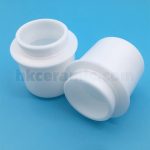
Customized Zirconia Ceramic Special-shaped Tubes
Material:Zirconia Ceramics
Describe:Customized zirconia (ZrO2) ceramic special-shaped tubes, also known as industrial ceramic threaded connecting tubes. Designed with precision threads for mechanical systems, these ceramic tubes ensure high-quality sealing and structural integrity. Their smooth surfaces reduce friction, optimizing fluid or gas flow efficiency.
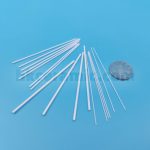
Zirconia ceramic Pin/Thin rod
Material:Zirconia Ceramics
Describe:Custom zirconia (ZrO2) ceramic gauges with 0.001mm tolerance offer precise measurements in high-pressure environments, ensuring accuracy and reliability.
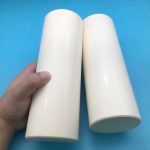
Large-sized alumina ceramic rod
Material:Alumina ceramics
Describe:Large-sized alumina ceramic rods, 99% alumina solid plungers, and other precision ceramic products excel in industrial applications with their outstanding heat resistance, corrosion resistance, high-temperature stability, and wear resistance. Widely used in manufacturing mechanical components, they are essential in fields requiring these qualities, such as high-temperature and corrosive environments.